Identify and come clean about the layered uncertainties, both in measurement and in outcomes
Delta Air Lines claimed to be the world’s first carbon neutral airline. Then it got sued. In a nutshell, the airline’s confidence got ahead of certainty regarding carbon offsets claims, a practice in which actual climate benefits are very difficult to verify.
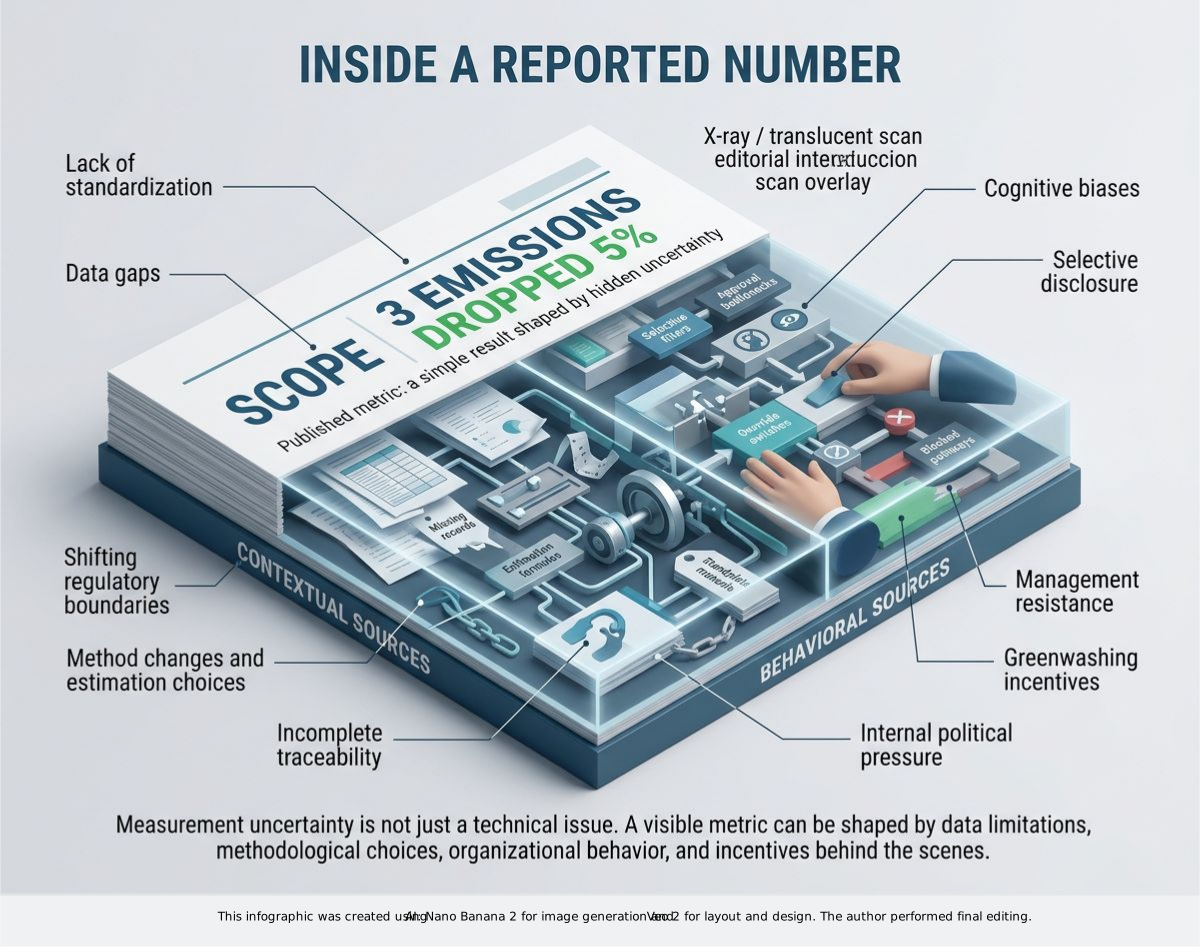
The Delta case is a window onto the wider sustainability reporting problem. A study forthcoming in Academy of Management Perspectives explores how the figures in corporate reports can look reassuringly precise while resting on fragile assumptions. The authors, from UCLA Anderson and the UCLA Institute of the Environment & Sustainability — Magali A. Delmas, Kelly Clark, Dylan Minor and Tyson Timmer — offer a road map to help managers diagnose and navigate such uncertainties.
The researchers’ conceptual framework guides practitioners in choosing the type of metric that fits the uncertainty involved and in determining when it’s more credible to rely on qualitative disclosure than to publish a misleading number. As the researchers put it: “Credibility, not transparency alone, defines the central challenge for contemporary sustainability measurement.”
At first glance, it might seem like an odd time to worry about better sustainability reporting. U.S. political winds have shifted on climate issues, and the EU’s sustainability reporting requirements were recently eased. Bloomberg reports that only 432 of the companies in the Russell 3000 filed a sustainability report in the first half of 2025 compared with over 800 companies in the same period the year before.
Yet, fires continue to burn and waters rise, close to home and globally. Even if leaders feel climate change is on the back burner for now, they surely know it will come front and center, regardless of political movements, soon enough. Initial efforts at disclosure were, well, less than perfect, as Delta learned. Trust in corporate environmental claims fell, according to the 2023 Edelman Trust Barometer. Now, the authors suggest, would be a good time to chart a more credible path for disclosure.
Two Kinds of Uncertainty
Credibility issues in sustainability reporting result from two forms of uncertainty, according to the researchers. Effect uncertainty asks whether an initiative actually produces its intended outcome. Measurement uncertainty asks whether the result can be accurately measured.
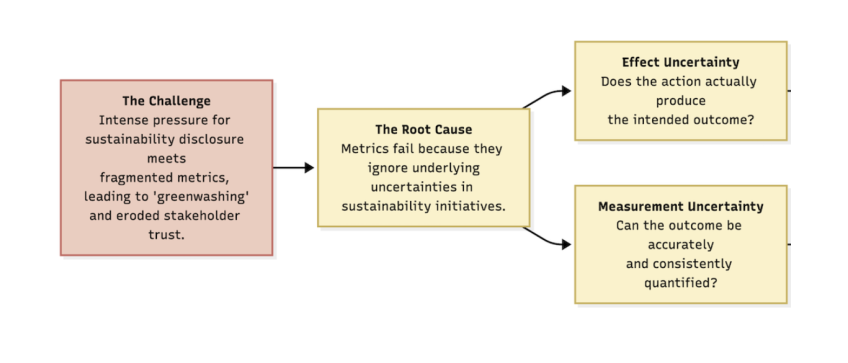
To navigate both uncertainties, the researchers develop a road map. Diagnosis is where things begin. The researchers prescribe a kind of medical triage to determine how much effect uncertainty and measurement uncertainty surround a given initiative. As in the emergency room, managers need to know what they are dealing with before they can try to treat it.
Then comes selection. The researchers developed a four-quadrant framework that guides a user to the appropriate type of metric given the intensity of each type of uncertainty.
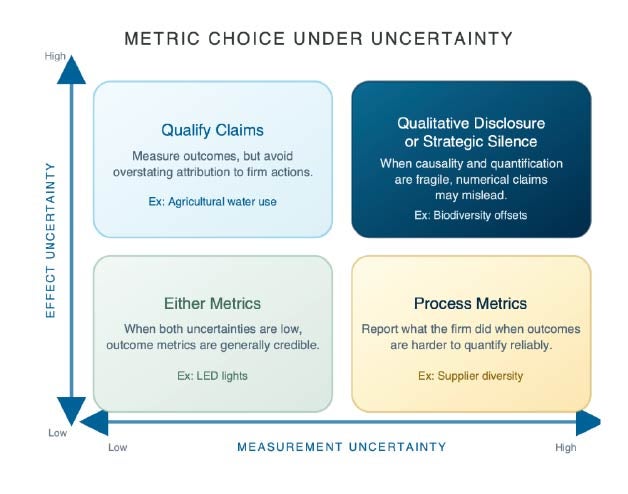
When both effect and measurement uncertainties are low, like for an energy efficiency upgrade with precise utility meters and predictable savings, outcome metrics are credible. A company can report that it reduced building energy use by 18% annually and expect to be believed. But when measurement becomes murkier, then process metrics tend to hold up better.
These report what the firm did, rather than claiming a precise outcome impact. To illustrate, it would be more credible for a supplier to report that they expanded their vendor list to 200 certified minority-owned businesses than to claim some imprecisely measured economic impact pulled from a complicated supply chain.
When effect uncertainty is high, but measurement remains precise, qualified claims are the recommended choice. Here, a consumer goods company might be able to accurately track a 12% decline in water use across its supply chain, but it can’t honestly attribute all the reduction to its own training programs when regional rainfall and government subsidies shifted during the same period.
Uncertainty + Uncertainty
But it’s where both uncertainties are high that the researchers make their most arresting argument. In those cases, they contend that publishing a precise number isn’t just imprecise — it may be misleading.
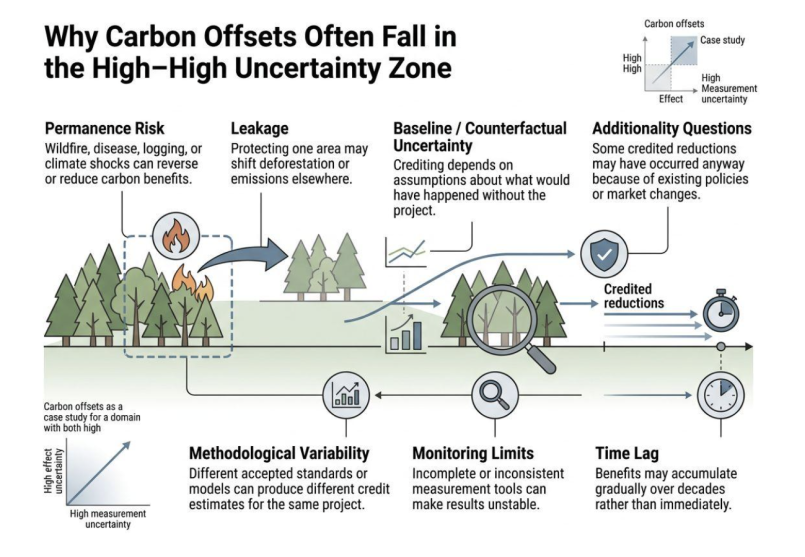
Carbon offsets, at the center of Delta Air Lines’ problems, sit squarely in this zone. Corporations buying carbon credits to offset emissions are implicitly claiming those credits will prevent a specific amount of atmospheric carbon from accumulating. But will they? The researchers note that the effect uncertainty is that we will never know for sure what would have happened if the carbon offset project was never put in place. Forests credited as protected might have been protected anyway by shifts in agricultural markets or preexisting conservation policies. A single wildfire can reverse years of claimed sequestration in days.
Even ecological conditions vary enough that two identical forestry interventions can produce much different carbon results depending on their site conditions, climate patterns and disturbance events. The same underlying forest project can generate substantially different credit volumes depending on which standard is applied.
Microsoft found significant over-crediting risks that were driven by inconsistent baseline assumptions when it conducted an internal review of its early offset portfolio. IKEA chose qualitative descriptions over premature figures for biodiversity restoration projects, and Patagonia took a similar path with regenerative agriculture, describing farming partnerships and ecological principles rather than publishing soil carbon numbers that measurement science couldn’t yet support. Delta changed course too, eventually pulling its marketing claims of being “carbon neutral.”
Delmas, Clark, Minor and Timmer suggest that move by Delta may have looked like backtracking but could be one of the more credible things the company did.

Silence, though, isn’t the endgame. The road map also outlines strategies for narrowing uncertainty over time. Companies can pilot initiatives at small scale, invest in standardized data systems, seek third-party verification, and communicate assumptions and numerical ranges transparently. Danone, for instance, tested regenerative farming practices with select farmers, gathering soil health data before scaling up. The goal is iterative improvement, gradually moving initiatives into territory where credible quantification becomes possible.
In situations where uncertainty still can’t be reduced to a reasonable level, the researchers’ framework calls for strategic silence. This means deliberately pausing all quantitative claims and providing a clear rationale and plan for when a quantified claim might be responsibly provided.
While the road map has yet to be empirically tested, it is primarily designed to guide voluntary disclosures — and to inform regulators seeking to build disclosure frameworks that account for the limits of what firms can responsibly quantify. It provides a thoughtful alternative to the instinct to publish more data, more metrics, more indicators. Credibility isn’t a function of volume. Sometimes the most credible line in a report is the one that admits the limits of what can be known.
Featured Faculty
-
Magali Delmas
Professor of Management; Faculty Director, Impact@Anderson
-
Kelly Clark
Institute of the Environment and Sustainability, Ph.D. candidate
-
Dylan Minor
Adjunct Associate Professor of Strategy
-
Tyson Timmer
Institute of the Environment and Sustainability, Ph. D. candidate
About the Research
Clark, K., Delmas, M., Minor, D., & Timmer, T. (in press). The Uncertainty of Corporate Sustainability Metrics. Academy of Management Proceedings.