City’s home-construction permits fall, while surrounding suburbs’ development expanded
The Los Angeles “mansion tax,” first assessed in April 2023 on luxury homes and other high-value properties, was supposed to bankroll much needed development of affordable housing. Instead, it seems to have gutted home construction at both the high and low ends of the city, suggests a working paper by UCLA Anderson’s Yingru Pan, a Ph.D. student.
Rather than easing the city’s already critical shortage of affordable homes, unintended ripple effects from the tax made it even worse, according to Pan’s calculations. Among her findings on real estate development after the tax, compared with 2018 to 2019 levels:
- Development of alternative dwelling units in the city plummeted 70%. These small, rentable backyard housing units are a key component in housing affordability efforts in Los Angeles and other cities facing shortages.
- Developers did not shift to multifamily projects, where affordable housing efforts are typically focused. The city’s multifamily construction permits dropped 27% overall, with no indication that developers were turning to cheaper apartment projects.
- Overall construction permits in the city fell 40%, a decline that includes a 45% drop in permits for single-family homes of any value.
Of course, housing construction is affected by myriad local and national factors. So, Pan compared city of Los Angeles data to 87 surrounding suburbs within Los Angeles County that were not affected by the tax. Suburbs like Beverly Hills, Pasadena and Redondo Beach saw raw permitting numbers decline, but not by nearly as much as in the city of Los Angeles.
Pan’s data is adjusted for how much each neighborhood typically built before the tax and controls for other factors, like home values. With these baseline adjustments, Pan observes that permitting in the suburbs generally was steady or growing modestly after the Los Angeles mansion tax, especially for single-family homes and ADUs, while construction activity within city limits plunged.
Her analysis suggests that the tax itself, rather than a broad decline in the real estate market, is responsible for the city’s construction drop-off.
Strategic Tax Avoidance
Despite the nickname, the mansion tax applies to any real estate sale of $5 million or more within the city of Los Angeles. That includes commercial properties like gas stations and retail strip centers. The tax is formally called “United to House L.A. Real Property Transfer Tax.” Rates are 4% on values between $5 million and $10 million, and 5.5% on more expensive properties, so comparable to adding another full broker’s fee onto a sales transaction.
Strategies adopted by developers and owners of $5 million-plus homes to avoid the tax appear to play heavily in its unintended consequences, according to the study. For example, a seller of a $5 million house could avoid a $200,000 bill if they accepted $4.99 million instead. Pan’s data suggests that even this small subset of the housing market — about 5% of Los Angeles homes sales were $5 million or more before the tax — can distort the overall markets.
She notes that prices on luxury homes spiked just before the tax went into effect April 1, 2023, to an average $6 million, and the number of transactions temporarily rose too, as sellers appeared to race to avoid paying the tax. Afterward, luxury market prices fell, and sales slowed to a trickle.
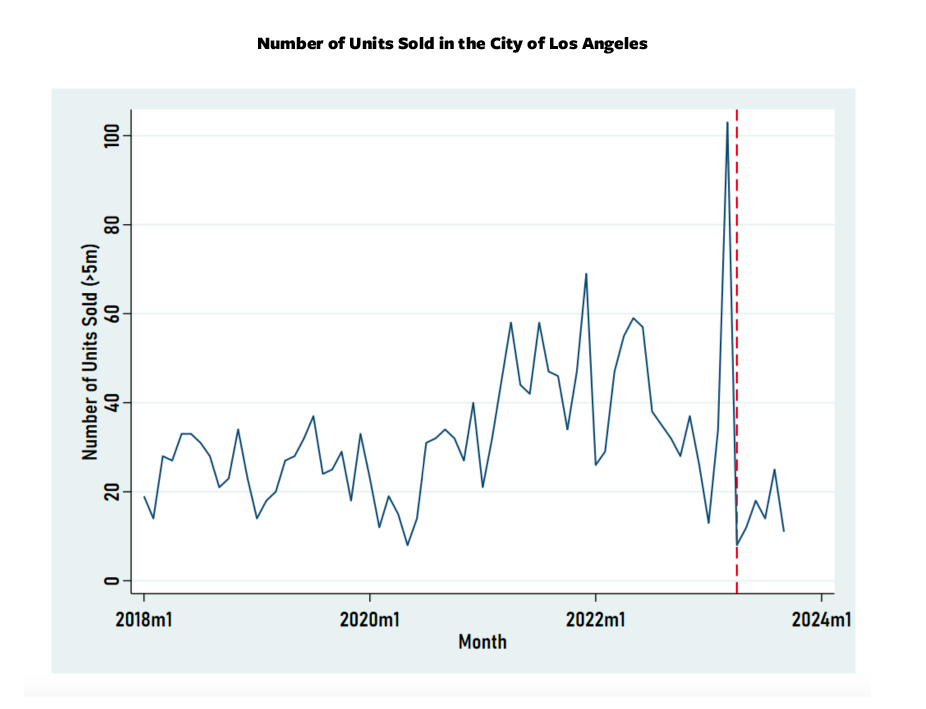
“Luxury homeowners increasingly opted to remodel rather than sell, reducing turnover and exacerbating supply constraints,” Pan writes. Renovation permits on luxury homes rose 46% after the tax became effective.
“Developers reacted by keeping new single-family projects below the $5 million and $10 million tax cutoffs or moving them out of the city of Los Angeles. Construction permits in the city for luxury homes fell between 15% and 19%, compared to constructions for mid- and low-priced single-family homes.”
Revenue from the tax was originally projected at $600 million to $1.1 billion per year. In its first 30 months, the city reports, the tax raised about $944 million, or a rate of about $378 million per year.
Pan’s research complements work out of UCLA’s Lewis Center for Regional Policy Studies, which has published studies looking at unintended consequences of Measure ULA broadly, as well as impacts on specific sectors of the city’s housing market.
In September 2025, Los Angeles Mayor Karen Bass, reacting to complaints about the tax, proposed a law that would have relaxed some provisions. It, too, came under criticism from both tax opponents, as not going far enough, and original backers of the tax and Bass withdrew the legislation.
Featured Faculty
About the Research
Pan, Y. (2025). Taxing the Top, Building the Bottom? The Impact of Los Angeles’ Mansion Tax on Housing Supply and Affordability. Working paper.
Manville, M. & Smith, M. (2025). The Unintended Consequences of Measure ULA.
Ward, J., & Phillips, S. (2025). Taxing Tomorrow: Measure ULA’s Impact on Multifamily Housing Production and Potential Reforms.