A levy on entering and expanding in an industry, on top of a per-unit extraction tax, tempers exploitation
On the morning of July 28, 1854, the captain of the whaling vessel Isabella reported 94 whaling ships could be seen from his deck. The next day’s logbook entry reported, “Saw considerable many more boats than whales.”
Whale oil and sperm oil were the illuminants and lubricants of the 19th century, and the flexible whalebone was used in products such as corsets — the world’s plastic before plastics existed. Together, they supported a valuable industry. The per-vessel revenue in the 1850s was about $17,000 (in 1880 dollars). That’s roughly $540,000 today and helps explain why the captain saw so many ships entering an already crowded hunting ground.
This paradox — prosperity intensifying depletion — is what economists call “the tragedy of the commons.” When a resource is open to all, individuals tend to overuse it, depleting the resource and reducing others’ returns. No single player in a commons setting has motivation to reduce their take — others would harpoon the whales they left behind — but the combined fleet, acting in individuals’ self-interest, and left unregulated, ruins it for everyone.
Mankind is currently facing up to perhaps its greatest commons challenge, global warming, in which the driver of every internal combustion engine-propelled vehicle, every factory and every country has an economic incentive to continue pumping out greenhouse gases, even as the world desperately needs to cease emitting them.
Economists have long struggled to quantify the social costs of exploiting a shared resource. In a working paper, UCLA Anderson’s Yangkeun Yun, a Ph.D. student, endeavors to do exactly that. He argues that a standard economic prescription for managing shared resources — taxing each unit of extraction — addresses only part of the problem. Such taxes curb overexploitation of the resource but do not fully address the problem of too many companies piling into an industry and overinvesting. Yun contends that a second instrument, a lump-sum license fee varying with a firm’s capacity and productivity, is needed. For example, a high-capacity firm would pay more than a small operator, reflecting the larger congestion costs it imposes.
Yun writes, “Optimal regulation combines per-unit taxes with lump-sum fees to discipline entry, exit and investment.” Without a lump-sum fee, firms in an open-access industry continue to enter and expand capacity.
Yun’s research is also applicable to modern-day fisheries, groundwater and spectrum congestion, where open access and crowding impose unpriced social costs.
Plenty of Fish in the Sea — Until There Aren’t
To study these dynamics, Yun needed an industry operating in an open access setting over a long time period with essentially no regulation. He found it in whaling. He assembled a dataset covering nearly all U.S. whaling voyages from 1804 to 1909. The key data source was the American Offshore Whaling Voyages Database, maintained by the Mystic Seaport Museum, New Bedford Whaling Museum and the Nantucket Historical Association.
Yun supplemented that database with crew records and manually digitized ship registers. This resulted in a dataset tracking more than 1,000 whaling agents (the primary decision-makers who planned voyages and hired captains) across roughly 10,000 firm-year observations. It included vessel tonnage, whale catches and, where available, crew sizes. Yun also linked these records to historical whale-product prices and a biological model of whale population dynamics to estimate how stock depletion of whales and ship congestion shaped production.
Yun then built a model of how the whaling industry evolved, companies deciding each year whether to enter, exit or adjust their fleet capacity. To make the model feasible to calculate, Yun used an approach that lets firms respond to a few industrywide summary statistics rather than track every competitor individually.
Yun studied how whale harvests related to these factors. And finally, he applied an algorithm, or set of rules, to calculate shadow prices for harvesting and for firms’ presence in the industry. Shadow prices function to capture the hidden social costs firms impose on others through their harvesting and excess capacity.
According to his analysis, a 1% increase in whale stock raised an individual company’s output by roughly 5%, while a 1% increase in aggregate fleet capacity lowered it by about 0.07%. Between 1820 and 1850, whale populations fell by an estimated 14%, implying a 54% decline in production efficiency. Yet fleet capacity over the same period grew almost sixfold, compounding the problem with an 11% efficiency loss from congestion alone.
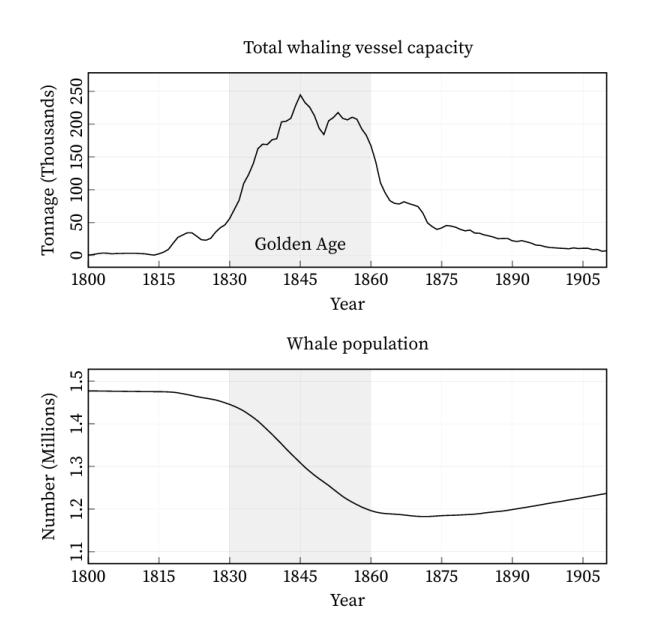
Those numbers seem like they’d spell doom for the industry. Yet it thrived for decades. Prices climbed sharply during the golden age, 1830 to 1860, driven by industrialization and demand for lubricants and illuminants. The industry’s decline only accelerated after petroleum was discovered in the U.S. in 1859. Whaling was further disrupted by the Civil War. But during the golden age, rising revenues kept firms entering and expanding despite the worsening conditions.
Yun ran “what if” simulations that experimented with changes in production, taxes, fees and demand. He suggests per-unit harvest taxes alone raised estimated social welfare — the economywide gains shared across consumers, producers and the government — by about 458% versus the unregulated baseline. Adding license fees that varied by a firm’s capacity and productivity, the combined levies improved social welfare by roughly 601% above the laissez-faire approach.
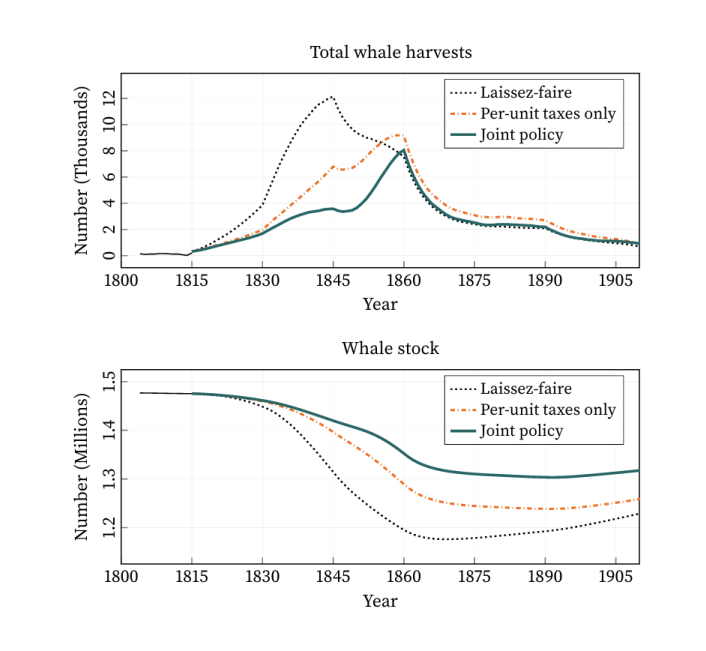
“Long-run growth in productivity and demand acts as an amplifier of inefficiency under open access but as a multiplier of welfare gains under well-designed policy,” Yun explains.
Featured Faculty
About the Research
Yun, Y. (2026). Navigating the Commons.