Half a trillion dollars wagered — and counting
With A-level celebrities hawking sports betting websites, it’s easy to forget that one could go to jail for running such gambling operations less than a decade ago. Until 2018, laying down a (legal) bet on a basketball game or other sports event usually required a trip to Nevada. Aside from some niche exceptions, no other U.S. operators could legally take sports bets — online or in person.
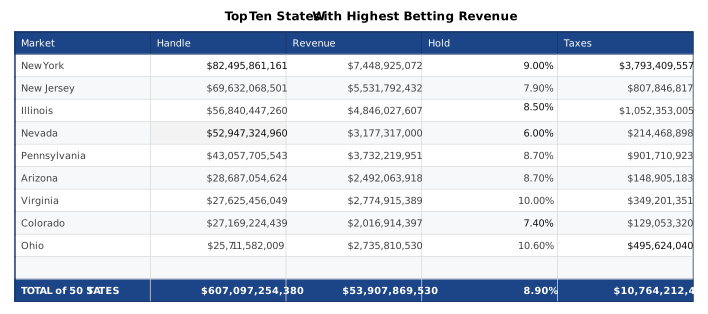
The Supreme Court changed all that by striking down a law that prevented states from authorizing and regulating sports gambling. Since 2018, 38 states have rolled out legal sports betting either online, in retail establishments like casinos, or both. Millions of Americans have embraced it, placing more than $150 billion in sports bets in 2024 — and some $600 billion overall, so far — according to Legal Sports Report. More than 95% of that money was gambled online.
Personal finances of residents in these states have suffered, according to data from a working paper by UCLA Anderson’s Brett Hollenbeck and University of Southern California’s Poet Larsen and Davide Proserpio. Consumers are more likely to carry excessive debt and struggle to pay it in states where a sports bet can be placed from anywhere with an internet connection, their study suggests. And general levels of creditworthiness have declined.
In states allowing online sports gambling, the likelihood of a personal bankruptcy filing rose 25% to 30% in the years after legalization, the data suggests. Average debt collection amounts rose 8%. Credit scores declined about 2%. Credit card and auto loan delinquencies both increased by around 8%.
Studying the Entire State, Not Just Its Gamblers
Legalizing in-person, or retail, gambling does not, for the most part, appear to create these problems, according to the paper. In states with retail-only gambling, negative effects were very small or not statistically significant.
Unlike much gambling research, this study does not attempt to figure out who bets and how it affects them. Instead, the researchers gathered anonymized financial data on about 4.38 million U.S. adults from the University of California Credit Panel, a database that’s supplied by a major credit bureau. They then calculated broad effects by analyzing credit scores, credit card balances, bankruptcy likelihood, loan delinquencies and other metrics for personal financial health across the state populations from March 2016 to June 2023.
The researchers looked for trends in these metrics that coincided with changes in sports gambling laws in each subject’s state. Legalization rolled out slowly, with each state making its own determination at different times about if, when and how consumers could place these bets in their jurisdictions.
By the end of the study period, eight states had approved only retail sports betting; three offered it only online; and 21 had made both legal. Sports betting in any form was still illegal in the remaining states. Data from Nevada, where sports betting has been legal since the 1940s, was excluded from the study sample.
For key findings, researchers compared data in states that had any sports betting with states where it remained illegal, or online access states to states that banned online betting or all sports gambling.
The data points to lower creditworthiness generally in sports gambling states, with the most erosion in states with online betting.
Featured Faculty
-
Brett Hollenbeck
Associate Professor of Marketing
About the Research
Hollenbeck, B., Larsen, P., & Proserpio, D. (2024). The Financial Consequences of Legalized Sports Gambling.