The shift spreads through auditors to other clients, potentially clouding the financial information investors rely upon
In the quarter century since the collapses of Enron (2001) and WorldCom (2002) raised awareness of the dangers of accounting fraud, about 25 companies in the S&P 500 are sued in a typical year for disclosures alleged to be misleading, according to Cornerstone Research.
A paper forthcoming in the Review of Accounting Studies by University of Georgia’s Frank Heflin, UCLA Anderson’s Mark P. Kim, Georgia Institute of Technology’s James R. Moon Jr. and Florida State’s Spencer R. Pierce finds that the initial act of being sued for securities fraud — regardless of whether the allegations will be substantiated — changes corporate financial reporting behavior.
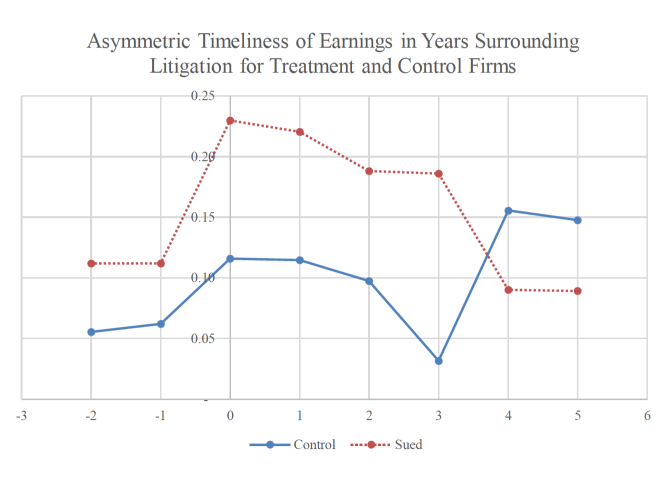
The authors find that in the first three years after a class action securities fraud suit is filed, firms accused are significantly more likely to recognize bad news in financial statements more quickly than good news — a key indicator of accounting conservatism known as asymmetric timeliness of earnings.
The researchers liken the sudden shift to more conservative reporting to car drivers laying off the pedal after receiving a speeding ticket … at least temporarily.
As shown in the dotted red line below, conservatism rises immediately when the lawsuit is filed (year 0), stays elevated for about three years, then gradually returns to prelawsuit levels.
Previous studies have shown that, when companies are sued, they often respond by becoming more cautious in their voluntary disclosures — issuing less optimistic guidance and warning investors about bad news more quickly. Past research has also focused on how firms adopt conservative reporting as a way to reduce the risk of future lawsuits. The work by Heflin, Kim, Moon and Pierce shows that conservatism also shapes how companies respond after being sued, extending into the choices firms make in what they report in their mandatory financial statements.
Conservatism may seem an absolute virtue. But for investors to have the most accurate picture of a company’s prospects, signs of potential upside are essential, too.
Spooked Auditors
The researchers’ analysis of more than 1,500 federal securities regulation lawsuits filed from 1996 to 2016 finds that the move to conservatism extends beyond firms actually sued.
An outside audit office whose client is sued for securities fraud appears to impose greater accounting conservatism on its other clients. The researchers find that firms sharing an audit office with a sued company showed a statistically significant increase in conservatism, while comparable firms with different auditors showed virtually no change. This suggests that a single lawsuit can influence the financial reporting practices of multiple companies. As a result, investors in firms not being sued may be making decisions based on financial statements that are more conservative — and potentially less accurate — than the firms’ underlying economic performance.
The researchers focused on litigation that accused firms of violating SEC Rule 10b-5, which prohibits companies from misleading investors. These cases typically allege that a company’s financial statements or public disclosures are misstated or omit material information. They’re often retrospective, meaning some bad news finally came out and the lawsuit alleges it should have been disclosed much earlier.
To measure the impact of being sued, the researchers examined how quickly bad news was reported in financial statements compared with the rollout of good news. They compared the changes in firms facing litigation to control groups of similar firms — matched by industry, size and, importantly, prelawsuit litigation risk — that were not sued.
Sued firms showed a statistically significant increase in how quickly they recognized bad news compared with good news, while similar firms not being sued showed virtually no change in their reporting behavior.
This lurch to more conservative reporting notably persisted even after federal regulators explicitly said it was not something the government endorsed, the researchers find.
In 2010, the Financial Accounting Standards Board removed conservatism as a desired feature of financial reporting, arguing that systematic pessimism could distort earnings and reduce their usefulness to investors. Yet the researchers document that firms sued under Rule 10b-5 continued to respond by becoming more cautious. This suggests that the experience of being sued shapes accounting behavior more powerfully than regulatory guidance.
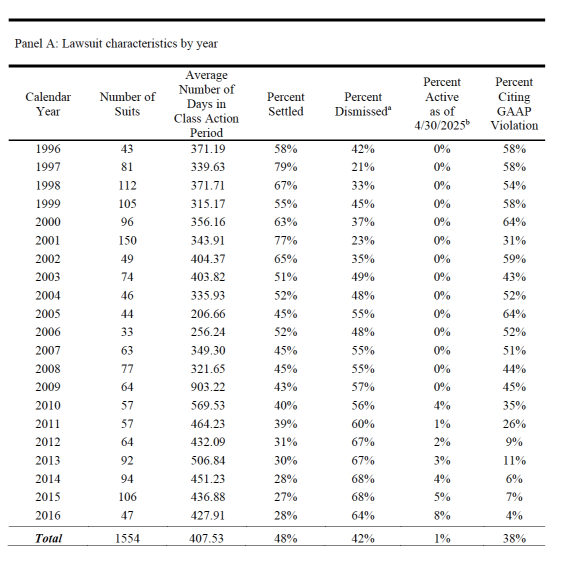
The persistence of this cautious behavior is all the more striking given that more than half of the lawsuits in the study were eventually dismissed. The research shows that legal ramifications are only part of the story. Being sued can trigger changes in financial reporting that spread through audit offices to other firms, potentially compromising the quality of the financial information investors rely on.
Featured Faculty
-
Mark Kim
Assistant Professor of Accounting
About the Research
Heflin, F., Kim, M.P., Moon Jr., J.R., & Pierce, S.R. (2025). Post-litigation reporting conservatism.