Chores go faster, providing more leisure time
In the not so distant past, planning a family vacation often meant hours and hours of web surfing for acceptable airfare, hotel or Airbnb reviews, deals on rental cars, videos on attractions and map after map to figure out the logistics of it all. For many of us today, a large language model spits out all that information in less time than it takes to write the prompts. Using links from the chatbot, we can finish up the bookings with time to spare for Netflix.
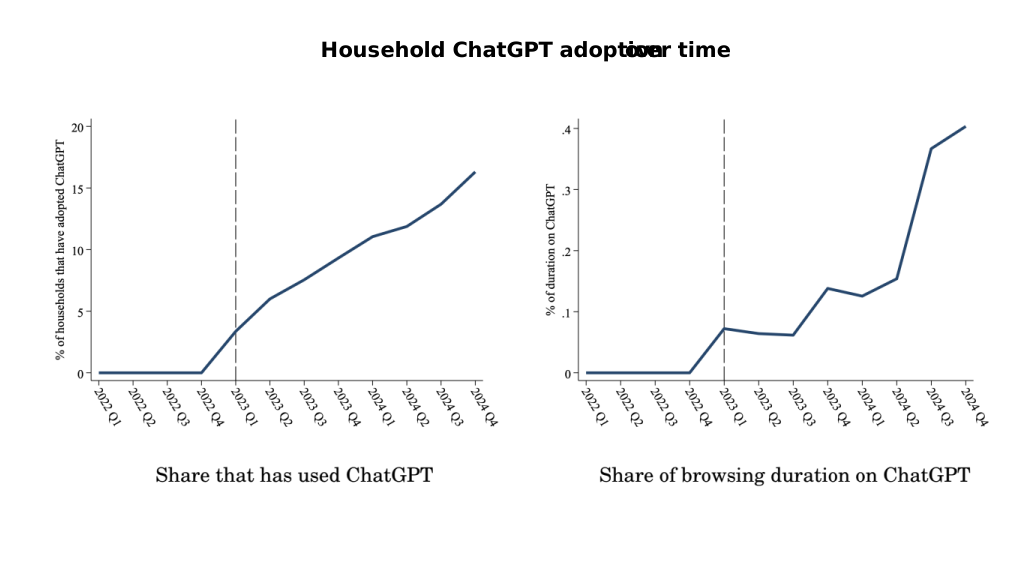
A working paper tracks this shift in online behavior at home using browsing histories from more than 200,000 U.S. households before and after ChatGPT’s public launch in late 2022. The findings, by Stanford’s Michael Blank, UCLA Anderson’s Gregor Schubert and USC’s Miao Ben Zhang, have economic and societal implications just as transformative as those raised in debates around workplace AI.
The research, along with observations of individual behavior, suggests profound changes in how people use AI to free up time and then take on new activities.
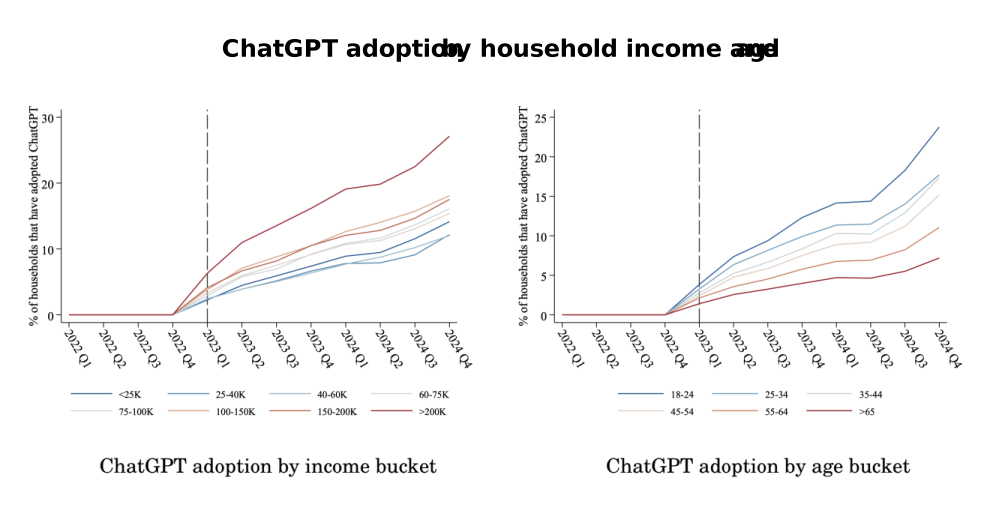
At the study’s core is a paradoxical result: ChatGPT use didn’t seem to change the amount of time anyone spent online at home dealing with “productive” household tasks. But households that adopted it added significantly more time to online leisure activities, like gaming, social media and streaming. Those that didn’t — they tended to be older and living on lower incomes — missed out on additional leisure browsing.
This is not because ChatGPT is used for leisure browsing — quite the opposite, in fact. About 80% of the households’ activity right before and after ChatGPT was seeking information, not fun, the study finds. The platform was used, for example, in the context of searching for jobs, researching gadgets, troubleshooting plumbing and explaining algebra to school kids. The fact that ChatGPT is used mainly for productive tasks — but users spent a diminishing share of their time online on these, suggests efficiency gains: By ditching hours of web browsing for minutes of ChatGPT, household AI users substantially increased how much they could accomplish in a given time, the researchers argue. While their study produces a range of estimates, they are mostly bigger productivity gains than reported by businesses, where users are more likely to be specialists with less to gain from pinging a bot for advice.
The findings underscore concerns about the survival of online information providers that AI users are abandoning to complete tasks. Adopters’ decisions about what to do with this found time — more work or more fun? — also will help decide what kinds of businesses, online or not, thrive in the future. And the reluctance or inability of certain households to adopt AI raises questions about who, demographically, gets to enjoy free time in this brand new uber-efficient world.
How People Actually Browse at Home
ChatGPT has already eliminated a lot of digital drudgery at home. Faucet leaking? AI diagnoses and offers up a step-by-step fix before you can find the first YouTube video that might, maybe, help. Tax issues? Those questions might eat up an evening searching for advice online. The bot will offer answers in seconds. Surveys as recent as November 2025 were still finding Americans more likely to use generative AI for personal research than in their jobs.
Blank, Schubert and Zhang wanted to know what kind of homes were adopting AI and for what, as well as how such adoption affects household productivity and leisure time. Using a large language model, they categorized websites as used for productive tasks, leisure, mixed or as an ad platform. For example, Google and other large search engines were labeled as productive; people go to them to get things done, even if the task is finding crazy cat videos. Instagram and ESPN got leisure labels. YouTube was tagged mixed.
Comscore provided the subjects’ browsing histories on home devices between 2021 and 2024, allowing the team to analyze shifts in the amount of time each spent online for productive tasks versus leisure with ChatGPT’s launch. That approach — tracking real-life usage in homes — is different from most studies of household AI use, which typically rely on surveys or lab experiments.
To help assess what subjects were doing inside ChatGPT, the researchers looked at what sites they were browsing within 30 minute time windows around talking to a bot. Some of the most popular sites in those times were Grammarly (writing and grammar assistance), LinkedIn (resume platform) and Quizlet (educational tools, like custom flash cards).
More Time Online, Spent Differently
ChatGPT use both increased the time households spent online and changed what they did there, the study finds. The share of leisure time increased 31 percentage points, while the productive part declined by 21 percentage points, according to the results.
After they start using ChatGPT, households spend more time online overall, but put most of it into leisure activities. As Schubert explains in an email exchange: “Overall time spent online becomes more attractive.” But, one would normally expect at least some additional time online to be spent on getting more productive tasks done, he writes. The fact that the subjects spent no additional time on productive browsing suggests large efficiency gains — of between 76% and 176% for productive online tasks, as the researchers compute using a model.
The study offers a few common examples in which AI makes work much, much faster than those estimates suggest. Pre-AI, that leaky faucet required 20 to 30 minutes browsing plumbing forums, comparing and assessing advice and watching video tutorials. ChatGPT can diagnose and write out a step-by-step fix in under two minutes. Product comparisons, adapting recipes and answering tax questions are 15 minute projects that AI often can answer in seconds, “implying efficiency gains of 500% to well over 1,000% for these specific activities.”
Those Left Behind
The gap between those benefiting from generative AI and those not is growing rapidly, according to the study. While adopters are collecting relevant job postings in seconds, mostly older and lower-income households are still slogging through LinkedIn and Indeed without help. The study found no sign they are catching up. The authors suggest that inequality might be addressed by policies that ensure access to AI across demographics.
Should we be worried about the additional time we’re spending online, leisure or not? The authors discourage using these findings to draw conclusions about how people spend their unpaid hours overall. They could not see everything these subjects did at home, including, notably, how and when they used smartphones.That browsing information was not part of the dataset.
But the scale and speed of the transition to AI in households, where people are getting productivity gains an employer might envy, suggests that home use “will likely constitute a substantial share of the overall economic impact of GenAI,” the authors write. Even if we eventually use that extra time to log off and take a walk.
Featured Faculty
-
Gregor Schubert
Assistant Professor of Finance
About the Research
Blank, M., Schubert, G., & Zhang, M.B. (2026). The Household Impact of Generative AI: Evidence from Internet Browsing Behavior.