Cultural shift under direct French rule appears to still drive today’s higher wages and consumption
There’s a provincial border in central Vietnam where workers on one side earn about 25% lower hourly wages than those on the other side. The gap is measurable along what was a roughly 150-mile border between southern and central Vietnam during French colonial times. And the cause traces back more than 160 years to a stalled military campaign.
A working paper by UCLA Anderson Anh Nguyen, a Ph.D. student, tracks that gap back to its source, and what it finds challenges conventional wisdom. In much of the world, the more intrusive a colonial regime, or extractive in terms of wealth and resources, the worse its long-run damage. For Vietnam, the opposite appears to be true.
No Individualism, Please
Before French warships arrived in 1858, Vietnamese villages operated as isolated worlds. They could be characterized by “the concentration of power in the hands of elites, the prevalence of collectivism as a social norm, and a general tendency toward risk aversion,” Nguyen writes.
The elites, also known as “mandarins,” ruled with almost absolute authority. They appointed their own replacements, controlled land distribution, tax collection and conflict resolution. Outsiders were explicitly unwelcome. Moving to another village meant losing rights and acquiring land elsewhere was actively discouraged. Even the traditional legal code, as one French admiral observed at the time, was designed “to terrify, by fear of the gravest punishment,” anyone who might challenge the authority of the mandarins.
Innovation threatened their power and migration drained their tax base. For these reasons, individualism was strongly discouraged.
A Leadership Vacuum
France’s initial plan was to capture Hue, Vietnam’s imperial capital, and colonize the entire country. But early military failures forced them south instead. There, six southern provinces became a colony called Cochinchina that operated under direct French rule. What came next transformed the region.
The Vietnamese mandarins in the south withdrew rather than serve under a foreign authority, so French officials flooded in to fill the vacuum. These officials abolished the region’s traditional legal codes and replaced them with French law. Confucian education was replaced with western scientific and technical subjects. Rules barring individuals from moving between villages or acquiring uncultivated land simply disappeared.
In the north and center of Vietnam — Tonkin and Annam —France later renewed its military campaign. These areas became protectorates governed indirectly by the French through the existing Nguyen dynasty. The mandarins stayed, and village councils kept their authority. And the old incentive structure, which punished risk-taking and rewarded conformity, continued largely undisturbed.
Economies Diverge
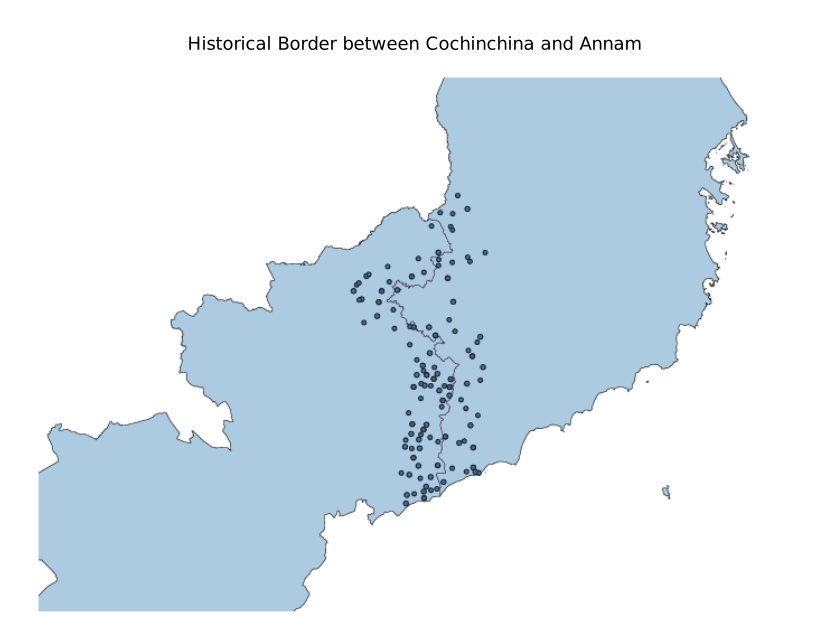
To isolate the effect of these two colonial regimes, Nguyen used a statistical method that compared communities within a narrow 25-kilometer band on either side of the historical provincial border between Cochinchina and Annam. She first confirmed that there wasn’t much variation in the elevation, temperature, rainfall and crop suitability between both sides. But their histories and economies became quite different.
Drawing on Vietnam’s Household Living Standards Survey from 2002 to 2012, Nguyen’s analysis suggests that household consumption per capita is roughly 20% higher on the former direct-rule side, and that individual hourly wages are 25% to 30% higher. Satellite nightlight data — a standard proxy for economic activity — also shows significantly greater luminosity on the Cochinchina side.
Nguyen confirmed that the economic gap wasn’t new. Data from the Hamlet Evaluation System, a wartime survey conducted by U.S. and South Vietnamese forces between 1971 and 1974, shows that villages in former direct-rule territory already had higher rates of TV and vehicle ownership, greater food variety, less need for subsistence assistance, and better access to schools and medical care. The colonial shock was so durable it persisted through one of the most devastating wars of the 20th century.
If simply better post-colonial governance explained the gap, Nguyen contends you would see it in public services today. But there are no significant contemporary differences in infrastructure, schools, markets or land certification across the border. The colonial institutions faded, but something deeper appears to have remained where there had been direct rule.
To search for the mechanism behind the differences, Nguyen conducted an original in-person survey of approximately 400 residents in two neighboring districts of Binh Thuan province sitting on opposite sides of the border. One was historically under direct rule, the other under indirect rule.
Respondents from the direct-rule side were significantly more likely to reject the idea that individual interests should be sacrificed for the group and scored substantially higher on an individualism index adapted from social psychologist Geert Hofstede’s widely used framework. When direct-rule survey respondents were offered a choice between a guaranteed payment of 160,000 Vietnamese dong and a 50/50 chance at 600,000 dong or nothing, they were more likely to take the risk to achieve a better economic outcome. The gap was widest among respondents under 35, who came of age long after the war and the colonial period.
Regional data from the Asian Barometer Survey reinforces the picture, with individualism scores noticeably higher in the south than in much of the rest of Vietnam, a pattern that does not line up neatly with current GDP levels. The Red River Delta in the north — one of Vietnam’s wealthiest regions — shows individualism just as low as its poorer northern neighbors. This result suggests collectivism is a deeply rooted cultural trait.
The French arrived in Cochinchina to extract wealth. By partly replacing the mandarin system to do it, they accidentally broke a centuries-old equilibrium. Nguyen argues that what appears to have grown in its place — a cultural shift in individual initiative, risk-taking and mobility — has outlasted the empire that created it all those years ago and is still showing up in household consumption data today.
Featured Faculty
About the Research
Nguyen, A. (2025). Breaking the Old Order: Colonial Shock, Cultural Change, and Economic Trajectories.