AI use in other countries doesn’t inspire domestic adoption, even when those competitors are right next door
Economic leaders across the developed world would really like their countries’ industries to get on board with AI, right now. The technology is expected to deliver the biggest productivity boosts since the personal computer and, by default, significantly boost revenue for any nation that harnesses it.
But AI can’t do anything that dramatic with spotty adoption. Consider the impact had only a handful of factories wired for electricity in the early 1900s. There would have been little incentive to train electricians, explore electricity’s potential or build out the grid.
A study across 12 European Union countries finds companies are motivated to adopt AI when they discover their domestic competitors are doing it. But laggards are not swayed to invest just because foreign companies in their fields are investing in it, even when those foreigners compete on an even playing field for their own domestic customers.
The findings are laid out in a National Bureau of Economic Research working paper by European Central Bank’s Ursel Baumann and Annalisa Ferrando; Harvard’s Zoe B. Cullen, UCLA Anderson’s Ricardo Perez-Truglia; Goethe University’s Ester Faia and European Central Bank’s Judit Rariga.
Despite the goal of a single market, much industry in the EU remains country-focused, which some believe hampers the region’s competitiveness versus the U.S. and China. The Continent, with few exceptions, isn’t producing giant technology companies to compete globally. The EU government sees AI investments as one necessary element to boosting competitiveness.
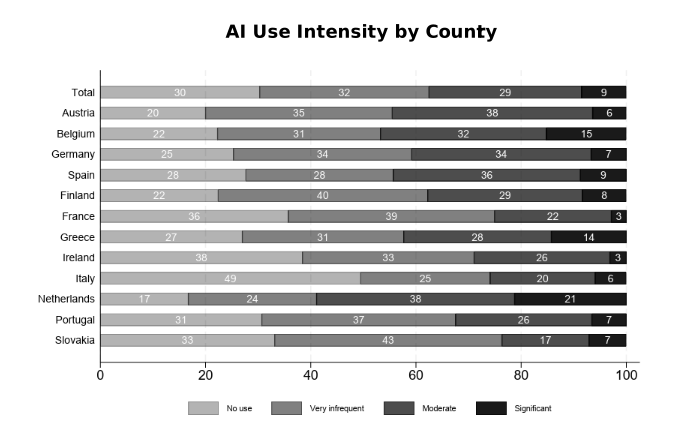
The researchers were allowed to embed their experiment inside the 2025 fourth quarter Survey on Access to Finance of Enterprises across the EU. SAFE is a joint project of the European Central Bank and the European Commission that samples top executives in nonfinancial industries on their business conditions, such as ability to get financing, or trends in turnover and revenue, as well as investment plans.
The experiment sample included 3,300 firms ranging from tiny to very large in four sectors: construction, industry, trade and services. The 12 countries varied too, from high AI adoption nations like Belgium and Finland to Portugal and Spain, where there’s a much larger group of holdouts.
The researchers first asked each firm to estimate what percentage of similar domestic firms — those in the same sector, size class and country as their own — had invested in AI. Then they asked for estimates of average combined adoption rates for similar firms in the three largest EU economies, Germany, France and Italy.
Most firms underestimated investment by both domestic and foreign competitors, often by substantial margins, the researchers report.
Half the subjects were randomly sorted to a control group and received no new information. The other half was immediately shown actual AI adoption rates by their own domestic and foreign peers. Later, all subjects were asked if they planned to invest in AI over the next 12 months.
Learning that more potential competitors were investing than expected appears to spark or accelerate AI investment plans. After the news, treated firms expected to allocate on average 10.13% of their investment to AI, compared with 8.33% among firms in the control group.
The researchers used a model to separate effects of foreign and domestic data. The model showed that the treatment effects were concentrated in firms that most underestimated domestic adoption. Levels of foreign adoption, even if much higher than a subject predicted, did not appear to influence investment decisions, the study finds. Subjects that overestimated others’ adoption generally did not change their own investment forecasts.
The research suggests that information diffusion can be a powerful motivator for AI investment, even though its power weakens beyond borders. The authors suggest that information campaigns may be a good complement to the financial incentives the EU already offers to incentivize AI adoption throughout the union.
The study is an expansion of one the authors conducted earlier with the Bank of Italy using the similarly embedded experiment questions in the country’s own survey of firms. That paper studied beliefs about competitors’ adoption of advantaged technologies. It found a similar domestic pattern: Factories initiated their own robotics installations and upgrades when they found out they were behind competitors in use of the technology.
Featured Faculty
-
Ricardo Perez-Truglia
Professor of Economics; Justice Elwood Lui Endowed Term Chair in Management
About the Research
Baumann, U., Cullen, Z.B., Faia, E., Ferrando, A., Perez-Truglia, R., & Rariga, J. (2026). Innovation Without Borders? The Geography of Technological Diffusion. Available at National Bureau of Economic Research.
Cullen, Z.B., Faia, E., Guglielminetti, E., Perez-Truglia, R., & Rondinelli, C. (2025). The Innovation Race: Experimental Evidence on Advanced Technologies. Available at National Bureau of Economic Research.