Where AI can do the heavy lifting, choice of freelancers is now driven more by price and less by experience
The arrival of generative artificial intelligence in late 2022 is transforming how businesses operate. Amazon, Salesforce, Allianz and HP have all cited AI as a driver of recent job cuts. JPMorgan Chase recently said that AI has enabled it to reduce staffing in some departments by 30% to 40%.
This seismic shift in staffing reflects the fact that human expertise is no longer necessary for certain jobs or tasks, and that AI’s processing speed far exceeds what even the most dedicated staffer can pull off.
A working paper suggests AI is also changing what employers look for when hiring.
UCLA Anderson’s Auyon Siddiq and Niuniu Zhang, a Ph.D. student, analyzed data from Upwork, an online job marketplace that connects freelancers with businesses looking to hire contract or remote workers. They find that in fields where AI can do plenty of the work, clients are placing less value on the strong credentials, polished pitch and great reputation of more experienced — and more expensive — freelancers. Instead, more work is going to cheaper, less-experienced freelancers who can use AI to up their game.
As AI narrows the gap between what a highly skilled worker can produce and what a less-experienced worker armed with AI can, those workers seem to now be more interchangeable. “If generative AI has a commoditizing effect on labor, workers with stronger human capital signals may lose part of their competitive advantage in the market,” the authors report.
While the research focuses on freelancing, the implications would seem to extend to the much larger universe of people who work for an employer. The AI-driven staffing moves at Amazon, Salesforce and JPMorgan Chase suggest that shift may already be underway.
Man Against the Machine
The researchers analyzed nearly 50,000 Upwork freelancers over 21 quarters, from the start of 2021 through early 2026 — a window that straddles the November 2022 public launch of ChatGPT.
Rather than sort profiles solely on a static list of attributes — knows Python, has an MBA — Siddiq and Zhang used language-processing software to better capture how freelancers positioned themselves. They then divided the data collected from each freelancer’s profile into four buckets for analysis:
- Self-presentation (how they describe their skills)
- Credentials (education and outside job history)
- Reputation (their ratings from Upwork clients on past work)
- Price
The researchers rely on earlier work that assigns each job category an AI-exposure score from 0 to 1.0, based on how much of the work a large language model could deliver. As shown in the table below, any form of translation, whether literal language translation or work involving legal or medical text, ranked as most exposed.
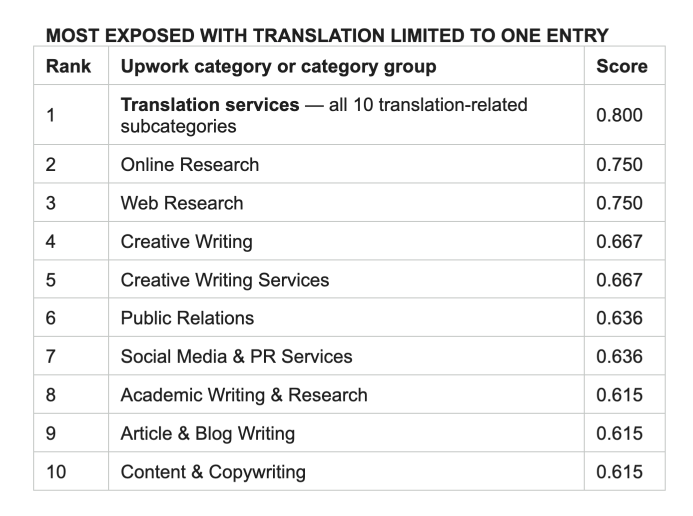
Visual and auditory creative fields ranked among the least exposed. Jobs with titles such as audio and music production, branding and logo design, and graphic editorial and presentation design seem safe. For now, all with a score of 0.0.
Credentials Lose Juice
To see whether AI changed what clients valued, the researchers compared heavily exposed fields, such as translation and writing, with fields that had little exposure, such as photography. They tracked, quarter by quarter, how much credentials, self-presentation, reputation and price helped predict who got hired.
Before ChatGPT, those measures moved in similar ways across both groups. But once ChatGPT became a valuable workplace tool, things shifted.
As shown below, the three human capital buckets (self-presentation, credentials and ratings) began to matter less, while price mattered more. The researchers estimate that for jobs highly sensitive to being replaced by AI, the human capital measures became about 7.8% less important in predicting who got hired than in unexposed categories. Price became about 1.1% more important.
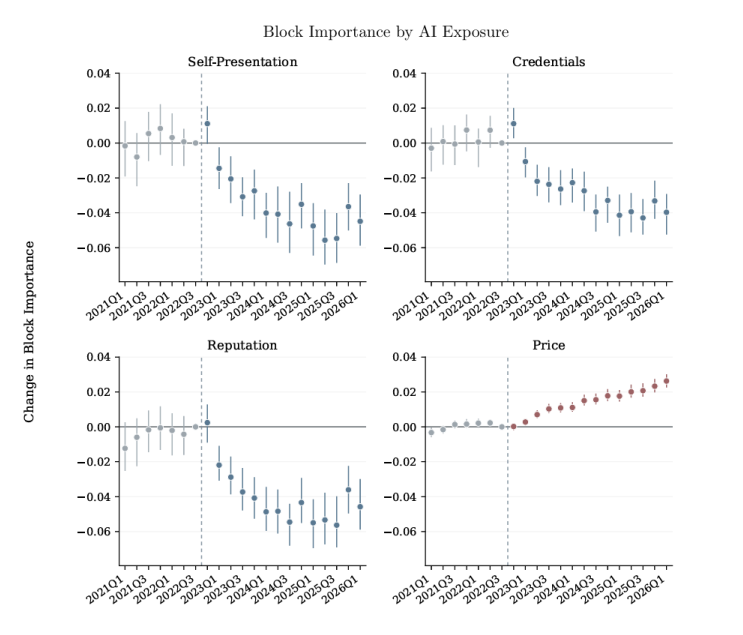
This shift was not simply the result of fewer jobs being available. Overall demand for freelancers in AI-exposed fields fell 7%, but clients also changed whom they hired for the jobs that remained. A competitive rate increasingly mattered more than a stellar portfolio, impressive credentials or a history of happy clients.
Siddiq and Zhang also found that those trends intensified over time.
By the final year of the sample, the combined importance of self-presentation, credentials and reputation had fallen about 10.1%, while the importance of price had risen about 1.8%. That suggests the impact of AI on hiring may still be in its early or middle innings.
Human Capital Loses Its Edge
To directly test the commoditization explanation, Siddiq and Zhang first established that before ChatGPT, freelancers with stronger credentials, reputations and profiles had a clear edge in getting hired. But after ChatGPT was out in the wild of the business world, that edge narrowed by 6.2%, and by early 2026 it had shrunk by 10.3%.
At the same time, demand for higher-priced freelancers didn’t increase, as it should have if clients were using price as a badge of quality. In the most AI-exposed types of jobs, there was a 7.9% increase in contracts won by less expensive workers by the end of their test period, suggesting interchangeability is indeed a factor.
The data cannot reveal exactly why any individual client chose one freelancer over another. Siddiq and Zhang also acknowledge that they cannot fully separate changes in how clients evaluate workers from changes in the types of jobs being posted. Yet their research finds a clear pattern: In work AI can readily assist with, stronger credentials and experience no longer deliver the hiring edge they once did. Increasingly, cheaper may be good enough.
Featured Faculty
-
Auyon Siddiq
Assistant Professor of Decisions, Operations and Technology Management
- Niuniu Zhang
About the Research
Siddiq, A., & Zhang, N. (2026). Human Capital, AI, and Labor Commoditization. arXiv preprint arXiv:2606.21880.