They hire remote: Loan officers in lower-wage areas lack knowledge about distant markets with strongest loan demand
Technology is transforming the American mortgage market. Online fintech lenders are capturing a growing share of the business, and traditional banks and credit unions are using technology to cut costs and speed up the loan process. A key strategy for both is to hire loan officers in lower-cost areas. You may be applying for a mortgage in San Francisco or Boston, but the loan officer handling your application might be working from somewhere with much lower wages, made possible by technology.
A working paper by UCLA Anderson’s Erica Xuewei Jiang, the Federal Reserve Bank of Richmond’s Yeonjoon Lee and USC’s Quinn Maingi suggests that chasing cheaper operating costs by relying more on remote loan officers isn’t necessarily a good deal for consumers.
The authors studied millions of mortgage applications from 2018-2019, sorting them by whether the loan officer was local, based in the same county as the borrower, or remote, meaning the next county over or thousands of miles away.
The researchers found that borrowers whose applications are handled by a remote loan officer face a greater likelihood of being denied. Not because they are riskier, but because a remote officer lacks the local knowledge needed to make a fully informed decision.
Strictly by the Book
The authors combined federal datasets to link loan applications to the location of the loan officer who handled them, and to the subsequent performance of approved loans. They then analyzed how much of each decision could be explained by the usual numbers lenders rely on like credit scores and debt levels.
For applications handled by local officers, those factors explained less of who got approved, suggesting local officers were drawing on what economists call “soft information.” While remote underwriters are limited to “hard data” — the rigid numbers that fit onto a spreadsheet — local officers can tap into something more: knowledge of the local economy, a feel for which neighborhoods, even which streets, are becoming more or less desirable and when something that looks risky on paper is actually routine in that market.
A local officer may catch a nuance that a remote decision-maker would miss. If a major local employer prefers independent contractors over salaried workers, a nonlocal underwriter may flag that income as risky. A local officer may recognize it as steady, reliable work.
That difference shows up in approval rates. For home purchase loans, local officers rejected 3.6% of applications while remote officers rejected 5.6%. For refinancings, local officers rejected 11.5% compared with 16.5% for remote officers. The gap is widest among borrowers who look riskier on paper.
Crucially, this isn’t a case of remote officers making smarter, more conservative decisions. Default rates are similar — or even slightly lower — when loans are processed locally. Local officers aren’t just approving more loans. They’re making better calls — approving more borrowers who are not greater risks, without increasing defaults, and avoiding some approvals that are more likely to go bad. Remote loan officers are being more cautious. But that caution shows up as higher denial rates without better outcomes.
Will AI-Evaluated Loans Be Even More by the Book?
The researchers put a number on how large that gap is. In the subprime segment of the market, their model suggests that as many as 15% of borrowers trying to refinance look too risky based on the numbers alone but are actually viable loans that should be approved. Local underwriting eliminates roughly half of these mistaken rejections while also reducing loans that are more likely to default.
The fact that the data covers a pre-AI period only makes the findings more relevant, not less. AI makes it more cost-effective to process applications based only on the numbers, so lenders have more reason to rely on it. But to the extent that pushes them to lean even more on remote loan officers, it comes with a cost. And so far, there is no evidence that AI has mastered the art of bringing a local’s insights into the decision process.
The researchers leveraged required federal mortgage data reporting that let them connect every application to the location of the actual loan officer who processed it. They then compared each county’s share of U.S. mortgage demand with its share of local loan officers, creating a “misalignment index.”
The map below shows the results: Red and pink counties are places where mortgage demand is high, but there aren’t enough people employed as local loan officers to meet it.
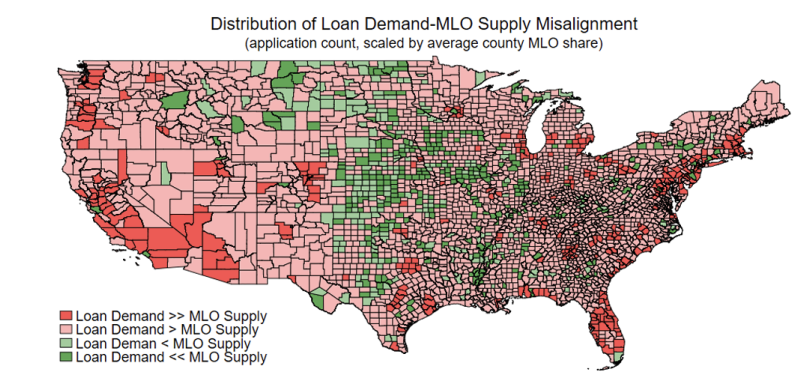
The driver of that mismatch is wages. Roughly 40% of purchase mortgage applications are handled by local officers nationally, but that share falls meaningfully as local wages rise. For each one-standard-deviation increase in local finance-sector wages, the likelihood of having a local loan officer falls by about 2 percentage points.
Thriving, high-wage markets — exactly the places with the most mortgage activity — are the ones most likely to be underserved by local underwriting. And the borrowers who feel that most acutely are the ones who look risky on paper and are most likely to benefit from a local human touch: those with lower credit scores or higher debt loads.
Management Focused on Cost Cutting
Remote lenders rely more heavily on the hard data submitted in the application. A local loan officer can bring in crucial soft information — about employers, industries and neighborhoods — that can shift an application on the bubble from denied to approved.
The researchers assert that lenders accept this trade-off because they aren’t looking at the big picture. Turning down an applicant who is on the bubble doesn’t get their attention as much as the immediate wage savings that come with leveraging technology to use remote loan officers. Yet, as the research shows, what lenders seem to be missing is that they are passing up thousands of viable, profitable loans that present no greater risk than the ones they are already approving.
The researchers model out an estimate of the value of local underwriting. Working with a local loan officer translated to a 0.64 percentage point increase in purchase mortgage approvals and a 2.86 percentage point higher approval rate for refinances.
To put that in perspective, based on Consumer Finance Protection Bureau application data, during the 2018-2019 study period, that translates to about 70,000 more purchase application approvals and nearly 200,000 refinances. That suggests technology, by driving underwriters out of high-wage markets, is inadvertently causing thousands of viable mortgage applicants to be turned down each year. As Jiang, Lee and Maingi show, those applicants do not appear to be greater risks for lenders.
Featured Faculty
-
Erica Xuewei Jiang
Assistant Professor of Finance
About the Research
Jiang, E. X., Lee, Y., & Maingi, Q. (2026). Credit Without Proximity: Informational Frictions and Unequal Gains from Technology.