Growing tension between behavioral research focused on the individual and the study of societal systems
A paper published in Frontiers in Psychology captures a central tension in behavioral research and public policy. When there is a societal concern to fix, research has largely focused on nudging individuals to alter their behavior, even though it is the policies and decisions of businesses and governments that have the power to drive change at scale.
That’s what UC San Diego’s Brent M. Wilson and UCLA’s Magali A. Delmas and Deepak Rajagopal observed when they reviewed 99 studies published between 2017 and 2021 that tested various types of behavioral nudges to reduce waste. More than 80% of the studies focused on interventions targeting individuals or households.
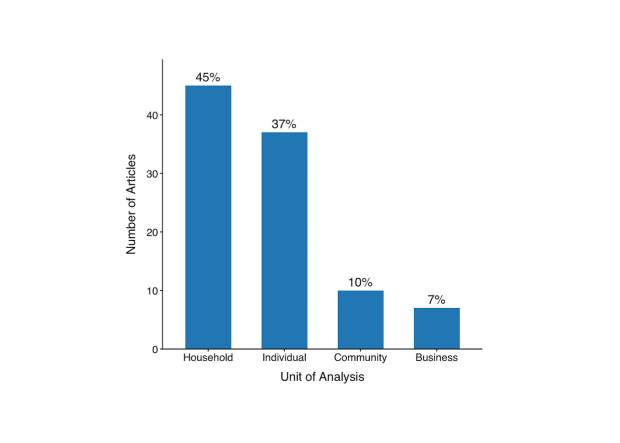
While many of the individual-focused nudges produced measurable changes in behavior, the researchers note that the heavy focus on individual interventions means there is much less attention on whether those changes add up to meaningful reductions at a community or system level. The role of businesses, institutions and governments — major contributors to overall waste and resource consumption — was studied far less.
It’s a striking limitation if the goal is broad change. Sure, using household gas and electricity meter readings to inform customers how they compare with their neighbors can change individual behavior, but that doesn’t ensure overall community consumption improves if businesses and governments are not similarly incentivized or tracked. Household trash recycling doesn’t guarantee less waste going to landfills if the community lacks the funding and infrastructure to process sorted materials and cannot find operators that will actually reuse the stuff.
A Limited Dataset
An influential 2022 article by behavioral researchers Nick Chater and George Loewenstein labeled this as the I-frame/S-frame dynamic. The I-frame focuses on changing individual behavior — what people choose to do. The S-frame focuses on changing the broader system through government policy, regulation and infrastructure that shape and measure those choices. Nudges can operate in both frames. But in practice, most research on solving problems, from obesity to low rates of retirement savings, has focused on nudging the individual. Chater and Loewenstein’s new book, It’s On You, details how business seems all too eager to make individuals responsible for fixing societal problems.
Wilson, Delmas and Rajagopal place waste reduction nudges squarely inside this I-frame/S-frame discussion.
They acknowledge that most of the research they reviewed is I-frame focused in part because these types of experiments are typically easier to implement than systemwide initiatives. But they note that these efforts “often yield modest, short-term effects.” Potentially more impactful — and currently less seen — are broader, system-level interventions, such as bans on plastic bags, which shift responsibility from individual initiative to societywide change and can produce larger, more sustained impacts.
“This individual focus risks overlooking the structural and systemic changes needed to achieve broader, sustained reductions in waste,” the researchers write.
The focus on I-frame research isn’t because of some blanket blind spot in academia. Researchers are largely working with the data that is most available. Utilities, for example, have been willing to share detailed customer usage, which conveniently is tracked by meters tied to individual homes. But other waste categories, such as household waste, are not as easily quantified. Tracking garbage typically requires research teams to physically collect, sort and weigh it — most communities lack the tools to do this themselves — which is expensive, logistically difficult and not easily standardized. So researchers gravitate toward what’s measurable.
The result is a literature that knows a great deal about electricity and water use, and far less about food and solid waste — and even less about how those household-level changes connect to outcomes at the level of a community, city or region.
Wilson, Delmas and Rajagopal’s decision to start the literature review in 2017 was intentional. That was when China stopped accepting other countries’ recyclable waste, effectively signaling it would no longer serve as a dumping ground. By forcing countries to manage their own waste locally, the Chinese policy shift exposed critical weaknesses in a global system that relied heavily on individual behaviors — like sorting one’s trash to prepare it for recycling — without the necessary infrastructure or systemic pressure on businesses and governments to support them. The reviewers chose the 2021 end date for their analysis to avoid potential pandemic-related distortions in behavior.
The Limitations of Nudges
Their review confirms that nudges can be effective, particularly when they are combined. In one study, informing people about their water consumption — and then adding a second nudge showing their neighbors’ consumption — reduced water use by as much as 38%. In electricity, the “here’s what you’re doing, and here’s how that compares” framing reduced consumption by about 3% to 7%.
Other interventions work by subtly reshaping the decision itself. Framing electricity conservation as avoiding a loss — rather than achieving a gain — cut usage by as much as 14% to 17% during peak periods. Making something easier — like adding a one-click link to download an energy report — boosted engagement by more than 200%. Even small emotional cues can work: Telling shoppers they were “fantastic” for buying imperfect produce increased those purchases by 92%.
Goal-setting also proves reliable. Asking people to commit to specific carbon-reduction actions increased their willingness to have their carbon footprint calculated by nearly 300%. Hotel guests who signed a simple pledge to conserve water reduced usage by about 16%.
Those are not trivial results. And the fact that 85% of the studies in the review were field experiments provides additional heft, as promising nudge results from lab experiments have frequently failed to replicate in the real world.
But as long as businesses and governments face no equivalent pressure to change — and there is limited investment in infrastructure and measurement needed to support those changes — even well-designed I-frame nudges are unlikely, on their own, to deliver change at the scale required.
In that sense, the research points less to a failure of individual nudges than to a mismatch between where most interventions are aimed and where the largest gains are likely to come from: commitment from S-frame stakeholders.
“We call for greater use of community-level and systemwide interventions, investment in scalable measurement tools, and stronger collaboration between researchers, governments and practitioners,” write Wilson, Delmas and Rajagopal.
Featured Faculty
-
Magali Delmas
Professor of Management; Faculty Director, Impact@Anderson
-
Deepak Rajagopal
UCLA Institute of the Environment and Sustainability, Professor
About the Research
Wilson, B.M., Delmas, M.A., & Rajagopal, D. (2025). Behavioral interventions for waste reduction: a systematic review of experimental studies. Frontiers in Psychology, 16, 1561467.