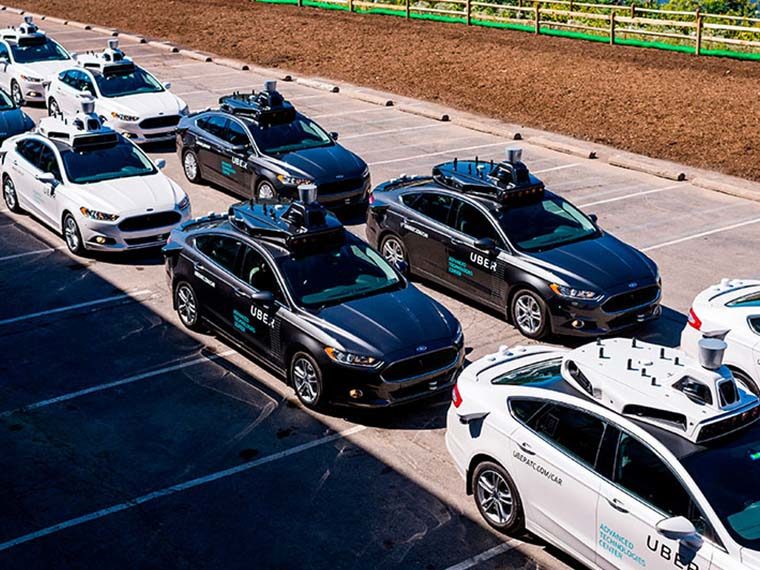
A model for dispatching and charging favors ... the Nissan Leaf?
As ride-hailing operators like Uber and Waymo increasingly deploy electric vehicles, they are discovering that the need to charge EVs, sometimes for extended periods, introduces enormous complexity into dispatching rides to waiting customers. Choosing the right dispatch strategy will be crucial to the companies’ bottom line and could directly affect prices customers pay.
Multibillion-dollar decisions around EV range, battery capacity and charging station networks will be crucial, as these companies continue scaling their operations within, and across, hundreds of cities. Getting it wrong could lead to unnecessary capital outlays and undermine competitiveness.
A paper published in Management Science by University of Michigan’s Sushil Mahavir Varma, UCLA Anderson’s Francisco Castro and Georgia Tech’s Siva Theja Maguluri offers a blueprint for efficiently making the transition to EV fleets. The researchers provide a framework that can help determine the minimum number of vehicles and chargers these companies need for providing a particular level of service.
Included is an algorithm, or set of rules, for a dispatch strategy that optimizes the use of EV fleets and charging infrastructure. Their paper challenges the conventional wisdom that longer-range EVs are usually better for commercial fleets. Based on simulations using real-world data from ride-sharing companies, the authors contend that a fleet of cheap, low-range EVs using a smarter dispatch strategy can outperform longer-range EVs.
Pairing Fleet Size and Charging Infrastructure
Varma, Castro and Maguluri used four key inputs to model the minimum fleet size and charging infrastructure needed: average number of ride requests, average trip time, how fast the vehicles charge versus how much energy they consume and the company’s service quality target. The service quality target could be fulfilling 90% of customer requests or keeping pickup times under five minutes.
This model relies mostly on data that ride-sharing companies already collect daily (and in some locales share with municipal officials). The researchers used a city of Chicago dataset with actual trips in Chicago by ride-hailing companies.
The trip data included the average number of ride requests that came in per hour and how long rides typically took on average and where they went. The researchers set their own service quality targets for the analysis and simulated charging stations spread randomly throughout Chicago. They also used ev-database.org to gather vehicle specifications including battery size, charging speed and energy consumption rates.
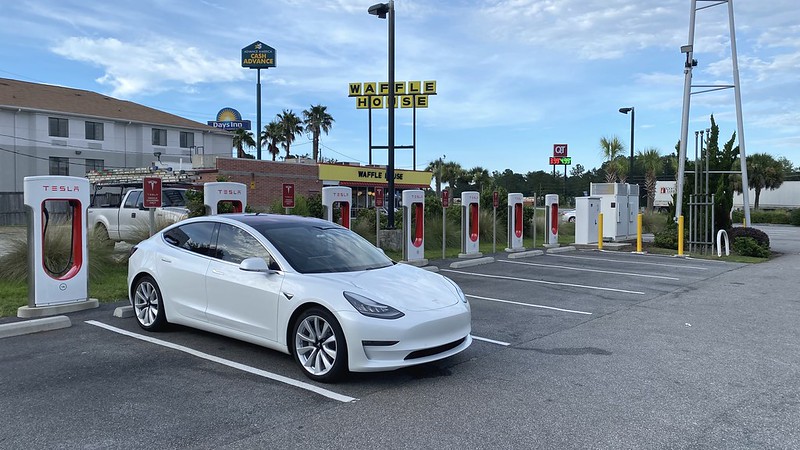
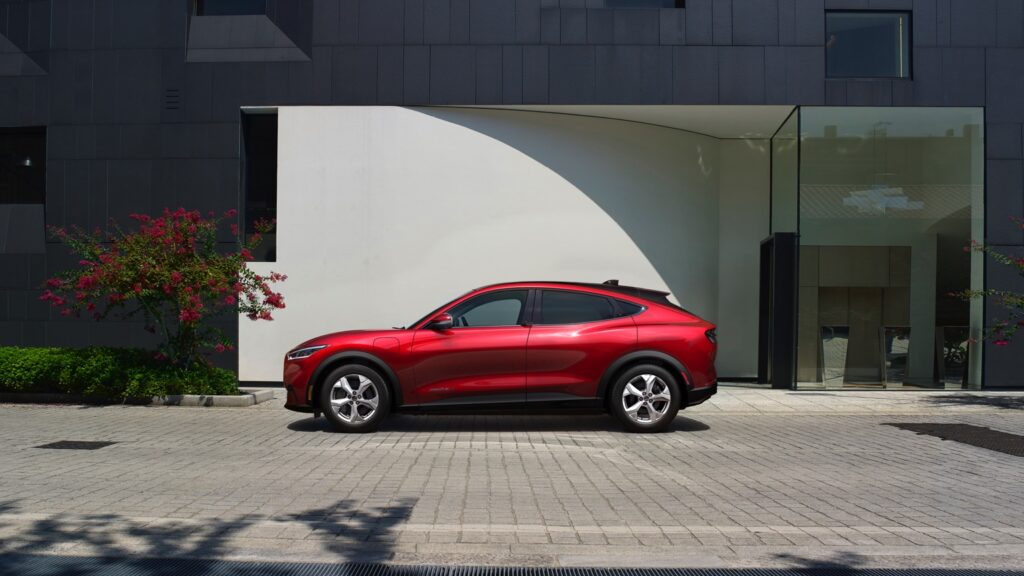
The vehicles from the study were the Nissan Leaf (approximately $30,000), Tesla Model 3 Standard Range ($40,000) and the Mustang Mach-E SR RWD ($50,000). After accounting for a typical 10% battery degradation after four to five years of use, the Nissan Leaf was considered to have a range of 130 miles (low range), the Tesla had 200 miles (medium range) and the Mustang Mach-E 260 miles (high range).
When dispatching vehicles, sending the nearest car minimizes customer wait time, but creates a problem: battery imbalance across the fleet. Cars closest to downtown may receive the bulk of ride requests, so their batteries drain quickly. Soon, you have a cluster of exhausted vehicles in the busiest area unable to accept new rides. Meanwhile, fully charged cars sit idle in the suburbs, too far away to be useful.
Instead, the researchers developed a dispatching rule in which an algorithm considers a particular number of the closest vehicles. If that number is three, then the algorithm finds the three closest vehicles to a customer and picks the one with the highest battery level. This helps balance the fleet and prevents clusters of depleted vehicles in high-demand areas.
The researchers added a crucial twist to their method: They included partially charged vehicles at charging stations among the possible candidates for the closest vehicles. Traditional thinking considered such vehicles out of service. But including these vehicles can significantly reduce the workload in the system and reduce fleet size requirements. That, in turn, can reduce the number of chargers needed. The researchers suggest that the “load-balancing” effect of this policy — distributing battery usage across the entire fleet —gives it a key advantage and is what helps to minimize the fleet and infrastructure requirements. Vehicles with higher charges are used more often while those with lower charges get time to recover.
Dispatch Strategy Beats All
Varma, Castro and Maguluri tested their predictions against four other dispatch policies in simulations using the Chicago ride-sharing trip data. Closer to how Waymo operates, the simulations assumed there was centralized control over the fleet rather than the Uber model of independent contractors making their own decisions, and that trips were evenly distributed across a region. They looked at the impact of each strategy across the three vehicles — low, medium and high ranges.
The other dispatch policies included:
- Closest Dispatch (CD) – simply pick the nearest vehicle.
- Closest Available Dispatch (CAD) – pick the nearest vehicle with enough battery for the trip.
- Power-of-TP, max (PoTP, max) – looks at all vehicles within a particular travel time radius and picks the one with the highest battery charge.
- Charge-at-Night (CaN) – primarily charges during off-peak hours (12 a.m. – 5 a.m.). (They noted a concern for the future: As ride-hailing fleets scale up, charging strategies that concentrate charging during off-peak hours could potentially strain the electrical grid.)
The simulations confirmed that the researchers’ dispatch strategy (considering a particular number of the closest vehicles, including those currently charging, and picking the one with the highest battery level) consistently outperformed the simpler, and more greedy, strategies, CD and CAD, across all vehicles. It was generally better or comparable to the PoTP, max strategy.
The most striking result in the simulations was that of a fleet of the Nissan Leaf, the cheapest and lowest-range vehicle considered, using their dispatch strategy could match the service level of the more expensive long-range Mustang Mach-E SR RWD fleet using a CaN strategy all while using fewer total vehicles. The researchers noted that their strategy automatically adapted its charging of the fleet to low-demand times during the afternoon and late at night, so it already incorporated some of the same benefits of CaN.
Overall, the study suggests that the choice of dispatch strategy can be more important than the choice of vehicle. Another insight from the study that researchers noted, “Our findings reveal a critical trade-off between fleet size and the number of chargers: Having insufficient charging stations can increase the workload in the system (drive-to-charger time) and lead to a higher fleet size requirement.” Adding more charging ports reduces fleet size requirements, up to a point. After reaching optimal charger density, adding more yields diminishing returns.
For companies planning to deploy electric or autonomous ride-hailing services, these observations could translate to big savings while maintaining service quality. City planners could also use these insights to determine how many public charging stations to build.
Featured Faculty
-
Francisco Castro
Assistant Professor of Decisions, Operations and Technology Management
About the Research
Mahavir Varma, S., Castro, F., & Theja Maguluri, S.(2025). Electric Vehicle Fleet and Charging Infrastructure Planning. Management Science).