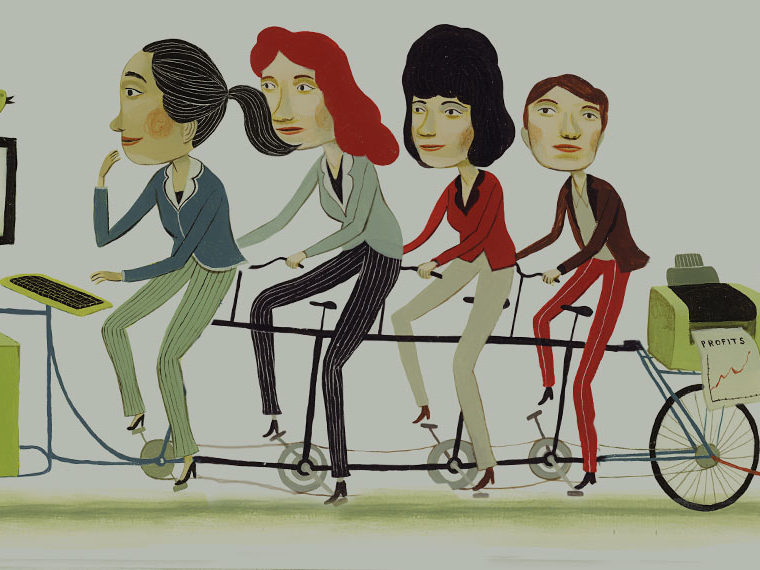
Informational cascades, revealed across three decades of research, compromise the work of corporate managers, surgeons, investors and others
Managers decline to hire strong candidates. Surgical teams decline kidneys ready for transplant. What’s happening here? In both cases, people are influenced by the choices made by those before them.
The hiring manager sees a gap in the résumé and presumes that other employers assessed the candidate and found something amiss. But nobody ever called the candidate in for an interview. A four-month break to care for a dying parent grew into an increasingly long gap as HR teams looked for reasons to reduce their final candidate pool.
The transplant patient is 15th in the queue. Her doctors know that the medical teams for patients ahead of her declined the kidney but they don’t know why. So, her team reasons that there may be a problem with the quality of the organ. The patients ahead of her may have simply been too unstable for surgery or a less favorable tissue match for the organ, but her team decides to reject the kidney.
In the chain of such rejections, each person reasoned from the pattern of choices made before them, reached a rational conclusion and then acted accordingly. But when taken in a sequence, those rational decisions can collectively lead everyone astray.
There’s a name for this. In 1992, UCLA Anderson’s Sushil Bikhchandani and Ivo Welch and USC’s David Hirshleifer (also at UCLA Anderson at the time) published a paper in the Journal of Political Economy that modeled this phenomenon, calling it an “informational cascade.” The paper would go on to gather more than 11,000 citations, influencing a research literature spanning economics, political science, law, marketing and medicine.

The study challenges the idea that a group should become smarter as decisions accumulate. Instead, it finds that when people are making decisions in sequential order, they can land on the wrong answer without realizing it.
Lopsided Math
The cascade starts when people stop relying on their own information and instead start following the choices made by the people before them. The cascade of choices made by people earlier in the queue simply overwhelms whatever information the next person privately holds. And once a cascade begins, each person who follows faces the same lopsided math. As a result, they make a similar follow-the-leader choice and this causes the group’s collective knowledge to stop growing.
A decision made in sequential order is at the heart of what enables informational cascades, but sequence alone is not enough. People also have to be able to see what others chose without seeing why they chose it. What may look like a strong consensus reflects nothing more than the choices made by the first few people in line. Flip the choices of those first few and everyone marches in the opposite direction.
Since 1992, many others have completed studies building on Bikhchandani, Hirshleifer and Welch’s foundational paper and the researchers themselves have authored and co-authored other studies advancing the research.
The kidney queue scenario is inspired by data from a 2010 paper published in Marketing Science. That paper examines 58 pairs of same-donor kidneys and finds that, on average across the data, one of the clinically identical kidneys is accepted 15 patients later than its “twin.” The study extends the original paper to the medical world while reinforcing with real data the theoretical ideas about cascades.
Turbocharged Cascades
With social media, we’re now seeing informational cascades amplified in two ways. The first is speed. Platforms compress the sequence of decisions that once unfolded over months into mere hours. A 2018 study published in Science brings the original research into the context of online social media by examining the spread of rumors and news on Twitter (now X). It found that retweets of false news stories reached 1,500 people about six times faster than true stories. The authors also found that false news appeared more novel and elicited emotions such as surprise and disgust in replies, while cautioning that these patterns do not by themselves establish a causal mechanism. Nonetheless, each share was a small step in the cascade, meaning a spreading chain of shares rather than a line of people setting aside what they knew.
The use of artificial intelligence can further turbocharge the spread through algorithms that detect early traction for a post and boost its distribution through recommendations.
AI can also play a role in the second transformation, scale. Producing large volumes of posts and variations of the same claim creates more early signals, and observers cannot tell that the posts are copies of one claim rather than the independent judgments of many people.
A cascade that once might have just rippled through a village can now reach millions. During the 2020 toilet-paper panic, sales spiked 734% in a single day. The cascade was visible on every Instagram story and local news broadcast, helping create the very shortage people feared. Panic buying blends the informational force with a second one. Each purchase does not just signal that others may know something. It also empties a shelf and makes the shortage real for whoever comes next.
It doesn’t take a lot of evidence to set off an informational cascade. A 2024 paper by Bikhchandani, Hirshleifer, Welch and Caltech’s Omer Tamuz, published in the Journal of Economic Literature, found that, even when each person’s private information is only slightly more reliable than a coin flip, on average fewer than four people act on their own private information before a cascade locks in. By the time the 20th person decides, the probability of not being in a cascade drops below 0.1%.
All of this differs from groupthink, which involves social pressure to conform. It also runs contrary to the “wisdom of the crowd,” in which the aggregate decisions or opinions of a large group are usually more reliable than that of any one person. This is because informational cascades prevent people from making independent decisions.
Fragile by Design
Bikhchandani, Hirshleifer and Welch contend in their original paper that cascades are structurally fragile. The social information people gather from watching the decisions of others is just strong enough to outweigh what any one person’s private information can add. It’s a thin margin. A single piece of credible public information — a news report, a visible contrarian, a demonstrable change in circumstances — may be enough to end a cascade, even one that has been running for a long time.
The rare person who sticks to their private information when facing a cascade may inadvertently be providing a social good. Holding out is the worse bet for them, because by that point, the run of earlier choices really is stronger evidence than one private clue. But their stubbornness supplies independent information to the queue. A 2025 paper published in Theoretical Economics extends this logic, arguing that “condescending” agents, meaning those who systematically underestimate the quality of their peers’ private signals, can improve overall social outcomes because they are harder to pull into a cascade and more likely to act as the disruptive shock that breaks one.
UCLA Anderson’s Antonio E. Bernardo and Welch, in a 2001 paper, explored the societal benefit of overconfident people, namely entrepreneurs, who ignore the herd and follow their own instincts, even if most startup businesses fail. Think of Elon Musk. Electric cars had been around for decades, yet not developed in the U.S. at scale, on the belief that the auto-buying market wasn’t ready for them. Musk ignored that industry wisdom — perhaps it was the product of an informational cascade — and Tesla’s surprising success changed the industry’s thinking.
As Bernado and Welch observed in 2001, “When overconfident, entrepreneurial individuals instead follow their own information, downweighting the information in the herd, their actions in effect broadcast their private information to the rest of their group. Unknowingly, overconfident entrepreneurs behave altruistically, making irrational choices that are to their own detriment but help their groups.”
Fragility is not a flaw in how cascades form. It is a direct consequence of the shallow information base on which they rest. It’s why fashions reverse overnight and why seemingly unstoppable political movements suddenly collapse.
Cascades are Everywhere
The fact that Bikhchandani, Hirshleifer, and Welch’s model can explain a wide breadth of phenomena is why the original paper generated so much further research. The extension of their ideas began quickly. A 1992 paper published in The Journal of Finance by Welch applied the logic to financial markets, specifically to explain the underpricing sometimes seen in initial public offerings. In the mechanism Welch modeled, the offer price is set before the shares go on sale and does not move, and investors are approached one after another at that fixed price. Those approached later can see whether the earlier ones bought, and they read that record as a powerful signal.
Welch’s model showed that this can lead later investors to ignore their own private research on the company’s value. If the first few potential investors commit, it can trigger a positive cascade of demand. But if they pass, it can create a negative cascade that dooms the entire offering. This helps explain the long-observed puzzle of why companies deliberately underprice their IPOs. A low price makes the first few investors willing to buy, which starts a positive cascade and shields the issuer against a collapse in demand.
But what if the object being evaluated can react? A 2003 study published in the Journal of Economics tackled this question in the labor market. Like in the opening example, it considered how employers infer candidate quality from unemployment spells in their work history. The research used a two-period theoretical model that allowed the worker to react in the second period by exerting effort to improve their chances of being hired. But it found that once a worker is in a cascade, their efforts in the second period couldn’t stop it.
Similarly, another study found that employers treat a candidate’s ability as increasingly irrelevant the longer the cascade runs. This 2008 study, published in the Journal of Economic Behavior & Organization, takes the idea from theory to real evidence. In 1999, the résumés of job candidates for administrative assistant positions were sent to firms advertising openings in a Swiss newspaper. Each firm received two applications, one from a person still employed, the other from someone who was not. The researcher varied the duration of nonemployment across applications. The results showed that beyond employers viewing long-term nonemployment as an undesirable characteristic for candidates, the longer that worker is without a job, the lower the probability they will be invited for an interview. Data for the Swiss applicants indicated that those without a job for two and a half years are 51 percentage points less likely to be invited to an interview than an employed person. The research states, “After a spell of 30 months, it makes little sense for an individual to keep applying for jobs because few firms will express an interest in hiring this person.”
Best-Seller Authors
In 1995, authors Michael Treacy and Fred Wiersema, along with CSC index — a firm where Treacy worked as a consultant — purchased about 50,000 copies of their own business strategy book. Purchases were targeted at stores they knew to be monitored for the New York Times bestseller list. With that push, the book made the list. And once there, it kept selling because readers interpreted its bestseller status as evidence that other buyers had endorsed it.
About a decade later, a 2006 paper published in Science reported a controlled experiment involving popular music. In it, 14,341 participants chose songs in an artificial music marketplace, either with or without knowledge of how many times previous participants had downloaded each track. The researchers found that download counts seen by some participants served as a social signal and, as that signal became stronger, inequality and unpredictability increased, its own version of an informational cascade. Reassuringly, the researchers note, “The best songs rarely did poorly, and the worst rarely did well.” But among the rest, a wide range of outcomes was possible. In other words, quality mattered, but social influence played a large role in determining which of the middling songs succeeded.
Toppling a Wall
Both the bestseller manipulation and the music experiment involved relatively low stakes. But a paper published in World Politics argued that informational cascades can scale to the fate of governments. The study illustrates that what matters in a cascade is not necessarily the quality of private information in the system but whether that information ever becomes visible. In previous studies of cascades, each decision kept private information out of the queue. Here, each round of visible action releases information that had been hidden.
The study applied that insight to the Leipzig demonstrations that helped bring down East Germany’s communist regime. Polls that were only accessible to high-ranking officials showed declining support for the regime for years, but unobservable opposition cannot start a cascade. When protests began in 1989, each week’s visible turnout gave the next wave of protesters the evidence they needed about the political opinions of their fellow citizens. Turnout also worked through a second force. A large crowd is safer to join than a small one, so every additional protester lowered the risk for everyone who came after. Protests grew from 6,500 people to 105,000 to 325,000 in a matter of months. The cascade of observable action unlocked the private information that sat in silence for years.
A 2009 paper published in the British Medical Journal raised the question of what happens when a cascade runs through the very community we rely on to correct it. The original cascade models focused on binary decisions, but this study argues that similar cascade dynamics can unfold within the world of scientific citations. Each time a paper cites a claim without independently verifying the underlying evidence, it acts, in cascade terms, like someone who ignores private information and follows predecessors.
The author of the paper constructed a complete citation network around a specific biomedical claim, that a protein associated with Alzheimer’s disease also injures muscle tissue in a rare muscle disorder. He traced how it hardened from a hypothesis into accepted fact. Supportive primary-data papers received 94% of the citations. Six papers containing data that weakened or refuted the claim received 6%. Hypothesis became accepted as fact through citation repetition.
While cascades are theoretically fragile and should collapse when contradictory evidence arrives, this paper shows, in some cases, why that corrective mechanism may never fire. When funding, publication and professional prestige all reward joining a cascade, the incentive to speak out as the stubborn contrarian is pretty much zero. Those rewards are a second force, one that works on incentives rather than information, and it insulates the cascade from outside information.
When Cascades Are Harder to Start
While incentive structures can make cascades difficult to stop, there are structural designs that can make them harder to start. One lever involves the order in which people act. When people considered “better-informed” are early in the queue, they can immediately trigger a cascade based just on their choices, so these people might be better placed later in the decision queue. There’s a historical precedent for this logic. The ancient Hebrew high court, the Sanhedrin, voted in inverse order of seniority, with the most junior first, precisely to prevent senior opinions from influencing less experienced peers. The U.S. Navy uses a similar practice today. It’s a practice businesses might consider implementing in their meetings.
A second lever involves what the research literature calls “sacrificial lambs.” These are early decision-makers who are prevented from observing the choices made by their predecessors. Because they act only on their own private signals, their choices are highly informative to everyone who follows. They essentially provide fresh information signals for later observers.
Bikhchandani, Hirshleifer and Welch’s research, and the studies that followed, developed a framework for navigating a world in which sequential decision-making is everywhere. Awareness of informational cascades helps us assess a group’s agreement when we see an apparent consensus forming. We can ask ourselves whether the group’s agreement is based on independent decisions or the choices of a few.
It’s worth remembering that the people inside an informational cascade made rational decisions based on the evidence in front of them. But they may not know whether the cascade they’re in is right.
Featured Faculty
-
Sushil Bikhchandani
Professor of Decisions, Operations, and Technology Management; Professor of Strategy; Howard Noble Chair in Management
-
Ivo Welch
Distinguished Professor of Finance; J. Fred Weston Chair in Finance