The few born into poor families who own an incorporated business see wealth gains similar to entrepreneurs from privileged backgrounds
A core tenet of the American Dream holds that anyone can climb the wealth ladder, regardless of where they start. In the enduring Horatio Alger framing, hard work, and maybe a break or two, is enough to go from rags to riches.
A working paper suggests it helps enormously if you already come from money.
UCLA Anderson’s Sarada, who goes by a single name, and Econ One’s Oana Tocoian studied whether entrepreneurship delivers on its promise as a path to riches. Using a dataset that tracks the income and wealth of parents and their adult children over more than 30 years, the researchers find that running a business does correlate with higher wealth. Among households that land in the top 1% of wealth by midlife, 91% owned a business during their early working years.
But not everyone gets the same shot at becoming an entrepreneur. At any given point in time, only roughly 5% of the families in the bottom half of the wealth distribution actively own a business, compared with approximately 70% of the wealthiest families (those in the top 1%).
Entrepreneurship Widens the Wealth Gap
The paper separates sole proprietorships and other less formal operations from incorporated businesses, which are generally more substantial. Owning an incorporated business can transform the fortunes of the few from poorer households who are able to give entrepreneurship a serious run. But Sarada and Tocoian find that there simply aren’t enough of them to move the needle, for society as a whole, on economic mobility.
“Entrepreneurship propagates wealth inequality across generations,” the authors report. “Improving access to entrepreneurship holds the promise of greater economic mobility in the U.S.”
Wealth attainment and the stories of company founders are tracked so closely and in such varying ways that it’s important to make clear what the Sarada-Tocoian study does and does not do.
Yes, there are plenty of stories of poor kids becoming fabulously wealthy – as a culture, we celebrate them – but they’re exceptions.
And, yes, 8 of the top 10 wealthiest individuals today are tech company founders, some, yes, from modest backgrounds, others not. But they, too, are exceptions. Rather than focus on these exceptional “tail” individuals, the study seeks to measure the wealth impact of merely having started a business that incorporates. Owning an incorporated business itself is a marker of prosperity and yet, an achievement more attainable than, say, founding Nvidia. In looking at the backgrounds of those who do that, the study takes us beyond anecdotes of exceptionalism and enables us to talk about the broader economic and cultural power of entrepreneurism.
Sarada and Tocoian find that the gap between those who start a substantial business and those who don’t isn’t explained by a child’s education or IQ. Having wealthy parents is the strongest predictor of whether someone becomes an entrepreneur and stays among the wealthiest households.
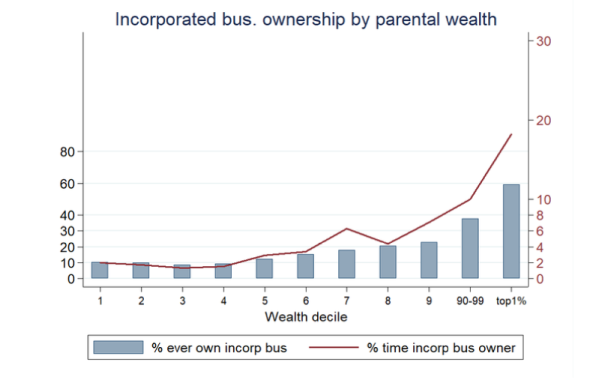
Still, when children from poorer households do manage to own an incorporated business — such as an LLC or a C corp — they can catapult themselves to real wealth. Just 4% of children whose parents were in the bottom wealth quintile rise into the top quintile if they never own a business. Among those who own an incorporated business, 21% make that same jump. Black entrepreneurs, the researchers calculate, see statistically similar wealth gains as white entrepreneurs once they get into the game.
“Entrepreneurs from disadvantaged groups are not of lower initial ability,” the researchers write. The problem is that poor children rarely get onto the entrepreneurial playing field at all. They may make a living as a self-employed service provider, but by not incorporating, they are not entering the heavy hitting entrepreneurial realm. Access to that realm, they write, “is primarily available to those whose parents are themselves in the top wealth quintile.”
Connections Are Key
The paper doesn’t offer direct causal evidence for why parental wealth predicts entrepreneurship, but Sarada and Tocoian offer some informed theories. “Our finding that having very wealthy parents … is the biggest predictor of entrepreneurship points to financial constraints as a first order concern,” they write. Wealthy parents may supply financing, a cushion against failure or an inheritance that makes starting and sustaining a business easier.
Parents may also open doors to business networks and offer guidance on the practical, unglamorous work of running a company: permits, suppliers, accountants and navigating the complex maze of local tax laws and regulations. And even if Mom and Dad are clueless on entrepreneurism, a well-to-do child likely goes to school with children of business owners so that the idea of starting something isn’t entirely foreign.
These advantages are particularly critical because the study reveals that casual self-employment or informal partnerships don’t yield the same economic rewards.
Sarada and Tocoian draw on the Panel Study of Income Dynamics, which has tracked American households since 1968 and began collecting detailed wealth data in 1984. Their core analysis covers 1984 through 2019 and pairs nearly 2,800 parents with their adult children, measuring each generation’s wealth between ages 40 and 55. The long time horizon allows the researchers to trace how parental wealth shapes access to entrepreneurship and mobility, though the study stops short of claiming direct causal links.
The researchers distinguish between adult children who dabbled briefly in self-employment, by necessity or choice, and those who stuck with it for at least a fifth of their working years. They further split long-term entrepreneurs by whether they incorporated their business or ran it as a sole proprietorship or informal partnership.
Controlling for parental wealth, parental education and occupation, the child’s own education, industry, state of residence, race, gender, age, marital status and immigrant background, households that own an incorporated business have, on average, wealth about 10 percentiles higher than those who only work for wages. If someone owns an incorporated business and works there, their wealth is about 14 percentiles higher than nonentrepreneurs.
And a sibling comparison, which effectively controls for family advantages, shows that a sibling who persistently owns and runs an incorporated business ends up roughly 10 percentiles wealthier than the sibling who doesn’t. Owning a business builds wealth on its own, regardless of family background.
Sarada and Tocoian find that having an entrepreneur parent predicts whether a child will go on to own an incorporated business, but only if the child finishes college. If the child of an entrepreneur does not graduate from college, they are more likely to follow their parent into self-employment or small, unincorporated businesses — the type of business ownership that doesn’t build nearly as much wealth.
Sarada and Tocoian also flip their research question by tracing today’s wealthy business owners back to their family origins. They find that more than half of wealthy households who own an incorporated business had parents who were also in the top wealth quintile. Among equally wealthy households who never started a business, only about a third had wealthy parents. That suggests wealthy entrepreneurs are more likely than other wealthy people to have inherited their spot at the top, rather than climbed into it.
Featured Faculty
-
Sarada
Adjunct Assistant Professor of Strategy; Faculty Director, Business Creation Capstone
About the Research
Sarada, & Tocoian, O. (2023). Entrepreneurship and the American Dream: How far Does the Upward Mobility Ladder Reach?