Dominant online retailer may help sustain higher prices and capture most of the resulting gains
Conventional wisdom suggests the company attracting the most customers raises prices first, and rivals follow. That assumption shapes one of the allegations in the Federal Trade Commission antitrust case against Amazon. A working paper suggests, however, that with algorithmic pricing, a dominant online retailer may help push prices up in a counterintuitive way, through its responses to rivals.
UCLA Anderson’s Eunsun Kim, a Ph.D. candidate, captured a set of product prices posted every couple of hours across major online retailer websites. That granularity allowed her to see the order in which competitors changed prices, and how they responded to one another. Amazon, considered the dominant player in her analysis, showed a distinctive response pattern: When a rival increased a price, Amazon was more likely to raise its own shortly afterward.
As Kim puts it, “Amazon’s distinctive role appears in the response stage: It is unusually likely to raise price after rivals raise theirs.” Kim calls this pattern dominant followership.
Consider a situation in which a pair of headphones is selling for $98 on the websites of both Walmart and Amazon. And suppose consumers make their purchases wherever the item is cheaper but, when prices match, they will favor Amazon — this could be because they find shopping through the platform more convenient. Walmart then raises the price of its headphones to $109. How should Amazon react? Holding at $98 would leave Amazon the cheaper option and win it sales.
But a few hours later, Amazon’s price also reads $109.
No Coordination Required
The numbers above are hypothetical but illustrate the pattern documented in Kim’s study. And the distinction between initiating price changes and responding to them matters in light of the FTC’s lawsuit. The agency accuses Amazon of using an internal pricing algorithm, dubbed Project Nessie, to steer the wider market toward higher prices. The FTC alleges that Amazon selectively raised its own prices when it expected other online retailers to follow.
Kim doesn’t argue whether her data prove or disprove collusion. Instead, she suggests that the pattern can arise without any communication between competitors or any requirement, say from manufacturers, to set a common price. And her model illustrates how responses resembling those in the data can be profit-maximizing.
The Sequential Advantage
From Nov. 24, 2024, through June 2025, Kim recorded prices about every two hours for 216 products matched by exact variant, including SKU, color and specifications, across major online retailers. This exercise resulted in nearly 1.02 million observations with products that included headphones, wearables, smart-home devices, vacuums and floor-care products. In addition to Amazon and Walmart, the retailers included Target, Best Buy, Home Depot and others. The Amazon and Walmart observations were restricted to their own first-party retail prices, omitting third-party marketplace listings.
Kim counted a retailer as having changed a product’s price only when she had already recorded that retailer’s price for the same product one to six hours earlier and the newly recorded price was different. In over 91% of the two-hour periods when a product’s price changed, only one retailer had changed its price. That usually made it possible to see which retailer changed its price and then track whether competing retailers changed their prices afterward.
Kim’s data cover a specific set of products, retailers and months, rather than every Amazon pricing decision. Within that sample, however, the pattern is clear: Amazon’s distinctive role appears in how it responds after rivals change prices, especially after rival price increases. The study suggests an astute pricing strategy by Amazon, and rational behavior by its competitors, in a market where Amazon’s position is strong and online prices are highly visible.
Kim’s data is notable because conventional retail datasets usually lack the frequency needed to identify who moved first. And standard pricing models usually assume simultaneous price choices. The difference is like seeing the final score in a game versus a series of snapshots of plays throughout the game. The snapshots can be viewed like a highlight reel showing the sequence of events leading to the final score.
The dataset also exposed a lopsided pattern. Sometimes Amazon just simply raised a price without responding to a rival’s price increase. That happened in roughly 10% of cases. But the probability of Amazon taking a price higher rose to more than 30% shortly after a rival raised its price for the same product.
Amazon’s price increases appeared to cluster in the first hours after a rival’s move rather than drifting in across the following 48-hour period Kim used to consider a price change. The timing doesn’t rule out common shocks (higher price from a supplier, for instance) affecting the firms, but it’s difficult to explain away as Amazon simply repricing more often.
Accounting for product, retailer, week and day-of-week differences, Kim’s analysis indicates Amazon was about 16 percentage points more likely to raise its price after a rival did in a broad test and nearly 13 percentage points in a stricter test. In the stricter test, Amazon’s estimated response was about 3.5 times as large as the response estimated for the other major platforms as a group.
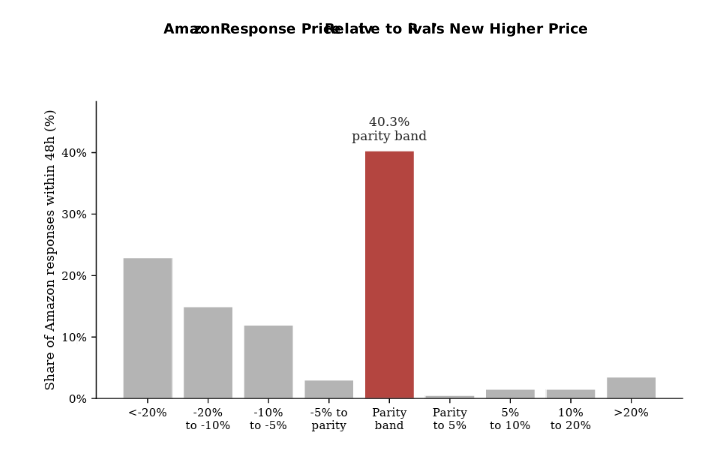
Roughly 40% of Amazon’s price responses to rival increases were at parity, meaning it matched. (Kim defines parity as matching the rival’s new price within about a dollar or 1%.) And those rival price increases tended to be stickier. Two weeks after a rival raised its price, two-thirds of the increases Amazon matched remained at or above the new price, compared with only around half of those Amazon did not match.
Replicating the Pattern Through Simulation
Kim’s model assumes that companies understand the incentives they face, but these forces are difficult to know in advance for retailers pricing tens of thousands of items. So Kim tested whether Q-learning agents could discover the same pattern just through profit feedback rather than supplying them with a demand model. To do so, simulations were run with a simplified version of a market of just two competing retailers. Both retailers learned by trial and error based on realized profits, a method in which an algorithm will try a strategy and record how much it earned. Over time, it leans toward the actions that had the highest payoffs.
One simulated retailer was given advantages like those enjoyed by Amazon: a disproportionate share of shoppers when prices are equal with the rival and the ability to respond more reliably to a rival’s price changes. Compared with baseline (no advantages), simulations showed that having the larger share of shoppers raised simulated prices. And even more effective at lifting prices was the superior ability to respond to competitor price moves.
The simulation’s matching response behavior showed the same qualitative pattern seen in Kim’s data. When the other retailer made a higher price move, the algorithm with both advantages matched it more than 80% of the time, compared with about 15% of the time when neither algorithm had an advantage.
And there was an unexpected result from the simulations. It’s the rival’s algorithm, rather than the dominant firm’s, that learns a price increase can pay off. In other words, the rival is the one who walks out onto the frozen pond to see if it holds. If it does, the dominant firm can match the higher price and benefit from the new price level. The rival takes on the risk of raising prices and initially losing sales as it comes to expect the dominant retailer to respond by matching. When only the dominant retailer’s algorithm was allowed to learn from experience, the higher prices didn’t take hold.
It’s Good to Be Amazon
Yet the algorithm doing the learning isn’t the one collecting most of the reward. In the simulations, the rival’s higher prices left the dominant retailer with the bulk of the added profit — because at matching prices, most shoppers still purchase through it.
Under those conditions, moving second can be more valuable than initiating the increase, when the second mover has a demand advantage and can profitably match a price that its rival would undercut if their roles were reversed.
For the dominant firm, undercutting would attract the rival’s customers, but matching allows it to charge more to the customers it already has, and the model assumes it attracts most customers when prices are equal.
In a market wired for rapid price reactions, Kim’s work highlights that the question is no longer only who sets a price, but who answers it, how quickly, and who captures the gains.
Featured Faculty
About the Research
Kim, E,. (2026). Following to Lead: Dominant Followership in Sequential Price Competition.