Custom database tracks movement of 5.3 million workers, reveals unappreciated economics of little-offered benefit
Paid parental leave is one thing a majority of Americans agree on. Though there is no federal mandate requiring that private sector firms offer this benefit, more than 3 out of 4 Democrats and nearly 6 in 10 Republicans surveyed by the AP-NORC Center for Public Affairs Research in June 2025 wish there was.
Yet despite the resounding support for PPL — the overall favorable rating was 67% — less than one-third of private sector employees work for companies that offer any form of paid family leave, including time to care for a newborn.
A working paper by UCLA Anderson’s Hillary Cookler, a Ph.D. candidate, suggests that employers worried about the cost of providing this benefit, or the equity optics of a benefit whose direct value is only for a small portion of their workforce, may be missing a big opportunity.
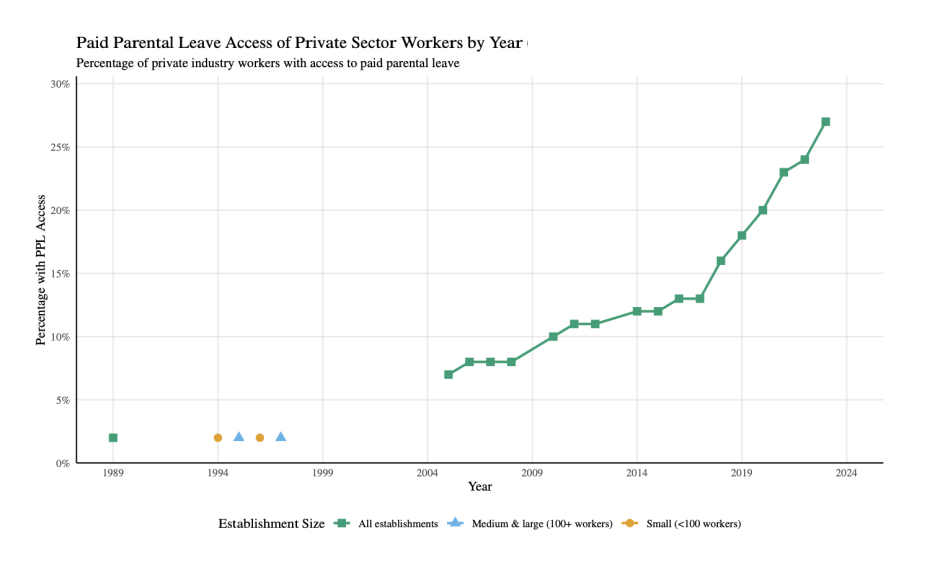
A series of analyses from Cookler’s custom-built database of 5.3 million workers at more than 200 firms that expanded their PPL benefits — providing a before-and-after look — suggests a causal link between the benefit and lower turnover. Given the cost of recruiting and training new hires, Cookler estimates that the savings from lower turnover when PPL is in play can typically more than cover the cost of the benefit.
Moreover, paid parental leave isn’t valued only by employees in their prime family-growing years. Using demographic data, Cookler sorted workers by their predicted likelihood of having a child within the next five years. Surprisingly, retention increased most among those least likely to have a child during that period. Some of that may be a function of people who may eventually tap the benefit. But the finding also suggests a broader halo effect may be lurking: Employees may see paid parental leave as evidence that the company cares about its workers, even when the benefit is unlikely to matter to them personally.
American Exceptionalism
“This signaling has the potential to strengthen organizational attachment and reduce departures even among workers who do not anticipate using PPL,” Cookler observes.
The fact that many countries — including France, Germany, Spain, Sweden, Norway, Estonia, Japan and Colombia — mandate generous parental leave is often waved off in the U.S. as a function of the structure of economies that levy higher taxes in return for more government-financed services.
Cookler’s finding that offering PPL is not necessarily a financial drain for U.S. firms punctures the notion that the benefit is too costly for companies to offer in an economy that already offloads most family benefits to employers and their workers (see: health insurance and retirement saving). Her research makes a case that PPL is good business.
More People Stick Around
Cookler manually collected data for her analysis, identifying 206 companies that introduced or expanded a PPL program between 2005 and 2025. She then combined this with data from Revelio, which scrapes LinkedIn profiles to track job changes and employment histories. In total, she analyzed more than 5.3 million worker profiles from those 206 firms.
She looked at employee changes in the 36 months before and after a firm introduced or expanded a PPL benefit program. She found that when companies introduced or expanded paid parental leave, employee departures dropped by about 3.4%. The impact is strongest among low-paid and junior women. Among executive women, PPL produced little additional retention benefit, possibly because its financial value mattered less while the career costs of an extended absence mattered more.
The causal case is boosted by further analysis that found turnover dropped immediately after a benefit was introduced or enhanced and held for three years. Men’s departure rates were flat before PPL policy expansions, and stayed lower for the subsequent three years, providing the cleanest evidence that the policy change, not other factors, kept people on the job. Women’s departures were elevated in the years before PPL policy expansions, suggesting some companies may have added PPL to address female attrition. Women’s turnover also fell after the policy change, though the preexisting pattern makes the women’s estimate harder to interpret on its own.
How to Turbocharge Retention
Cookler estimates that if companies wanted to achieve a similar reduction in employee churn through pay incentives it would require giving everyone a 2% raise.
Her analysis also makes a case for bundling PPL with other family benefits. Firms that paired PPL expansion with benefits like fertility assistance or child care support saw the retention effect for women nearly quintuple, from roughly a 2% drop in departures to nearly 10%. Pairing PPL with unrelated perks, like a bigger 401(k) match, showed no such lift.
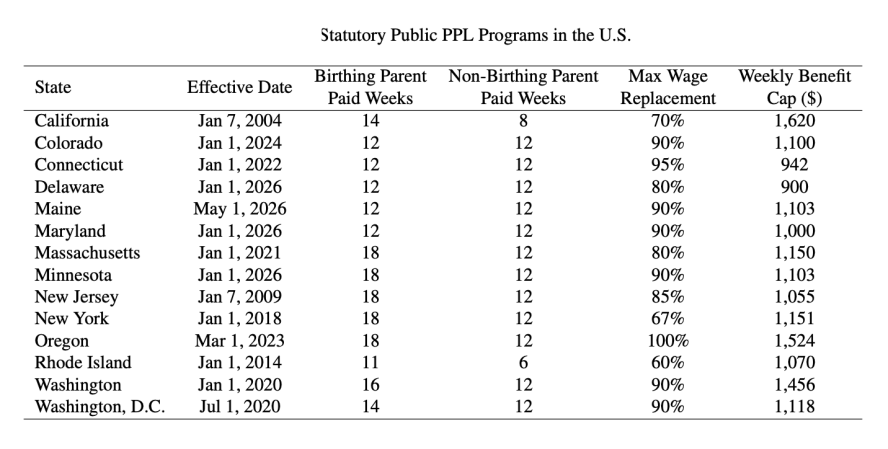
Cookler’s analysis also suggests firms operating in the 13 states (plus Washington, D.C.) that now offer statutory public PPL entitlements can benefit from also offering their own benefit as well. Public and firm PPL benefits are concurrent: The firm tops up the state benefit to as much as full income replacement during overlap weeks and covers any weeks beyond the state entitlement. All-in the employer gets the payoff of higher retention by offering its own benefit, yet it likely shells out less in PPL given the state paid first.
One limitation of this research, Cookler points out, is that her analysis relies on people keeping their LinkedIn profiles up to date. If someone leaves a job but doesn’t update their profile, the data will mistakenly show them as still working at that company.
Employee Turnover Is Costly
Having established that offering PPL lowers turnover, Cookler had to make a series of assumptions to analyze the cost-benefit proposition.
Past research has established that recruiting and training new workers can cost between 150% to 250% of the annual salary for that hire. That wide range reflects differences in the training needed for different jobs, and the varying expenses for workers higher and lower on the corporate ladder. Cookler opted to use a 50% cost to fill an open position, to establish a very conservative baseline.
She also had to make assumptions about how long an employee stays home to care for a newborn. In her database the median post-expansion benefit for the birthing parent was 14 weeks, and eight weeks for the non-birthing parent. Yet past research has shown that parents don’t typically use all the allotted time; mothers on average take about seven weeks of leave, and fathers less than a week.
Cookler calculates that if workers grabbed every week available, PPL would not pay for itself; on average it would cost employers $1 for every 46 cents saved on lower replacement costs given there are fewer quits.
But when she looks at how PPL is more commonly used — the seven weeks claimed by mothers and less than one week by fathers — the payoff emerges: She calculates a firm gets a $1.57 benefit (in lower turnover costs) for every dollar of PPL disbursed. That assumes replacing a departed worker costs only half their annual salary, and at higher replacement costs estimates, the net return to firms increases.
Given the wide range of potential costs for employers, and potential usage levels, the rubric below shows how the two variables interact. Shaded blue areas are where the benefit is greater than the cost.
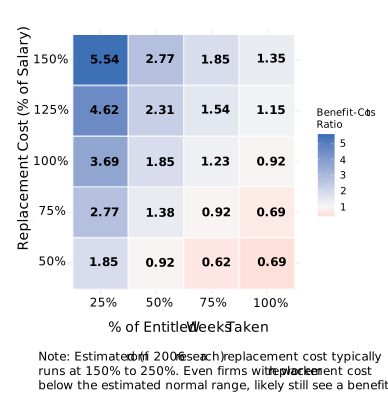
When average replacement costs are 125% or 150% of the salary for that position, PPL pays for itself, whether employees use 25% or 100% or the maximum weeks allowed.
Even at the still conservative assumption of replacement costs being 100% of salary, the math works for nearly all scenarios; only when employees take 100% of the weeks offered (a level of takeup exceeding anything observed in the U.S.) would a firm spend more than it gets back in lower turnover costs (a 92 cent return for every dollar in PPL spent.)
Given the strong support for PPL, Cookler’s findings address two common objections to paid parental leave. The benefit seems to have broad appeal, and for companies facing higher replacement costs, it can be an effective way to reduce turnover that often more than pays for itself.
Featured Faculty
About the Research
Cookler, H. (2026). Bucks for Bumps: How Paid Parental Leave Pays Off for Firms.