Improved voter targeting and the rise of nationalized campaigns may help explain this disconnect
Power in Washington is increasingly tenuous. Control of the House and Senate flip more often based on narrow seat majorities, and presidential election outcomes often hinge on slim Electoral College margins.
In a working paper, UCLA Anderson’s Clemence Tricaud and Romain Wacziarg spotlight a striking puzzle. Looking across more than 35,000 House, Senate and presidential elections since the Civil War, they document that control of Congress and the White House now hinges on slimmer seat and Electoral College margins, even though most individual races are still won comfortably. Indeed, at the state level (for Senate and presidential elections) and at the congressional district level, double-digit victory margins have remained the norm since 1952, even as electoral outcomes at the national level (in the Senate, House and Electoral College) have become closer and closer.
That may help explain why some Americans view the system as unfair. As Tricaud and Wacziarg write, “The disconnect between large vote margins at the constituency level and tight seat margins at the national level can make voters question the legitimacy of elected officials and heighten their perceptions of polarization.”
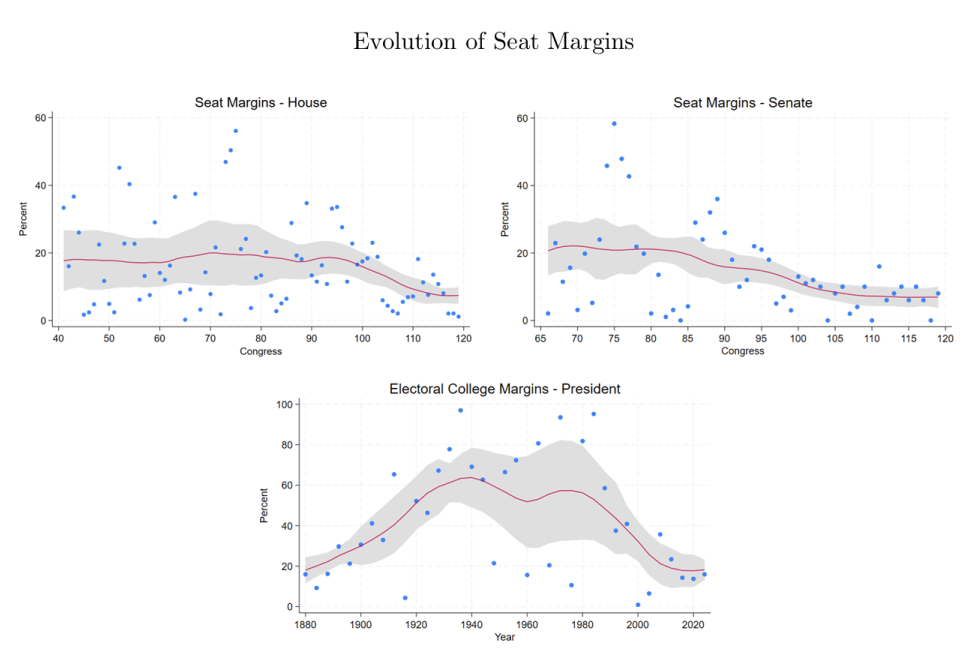
The researchers provide historical context for the modern day dynamic of close national outcomes. Seat margins at the national level have decreased in the last 60 years, from an average of 20% to less than 10% today, a trend that holds for the House of Representative, the Senate and the Electoral College (as shown in the graphic below).
Locally, a Different Story
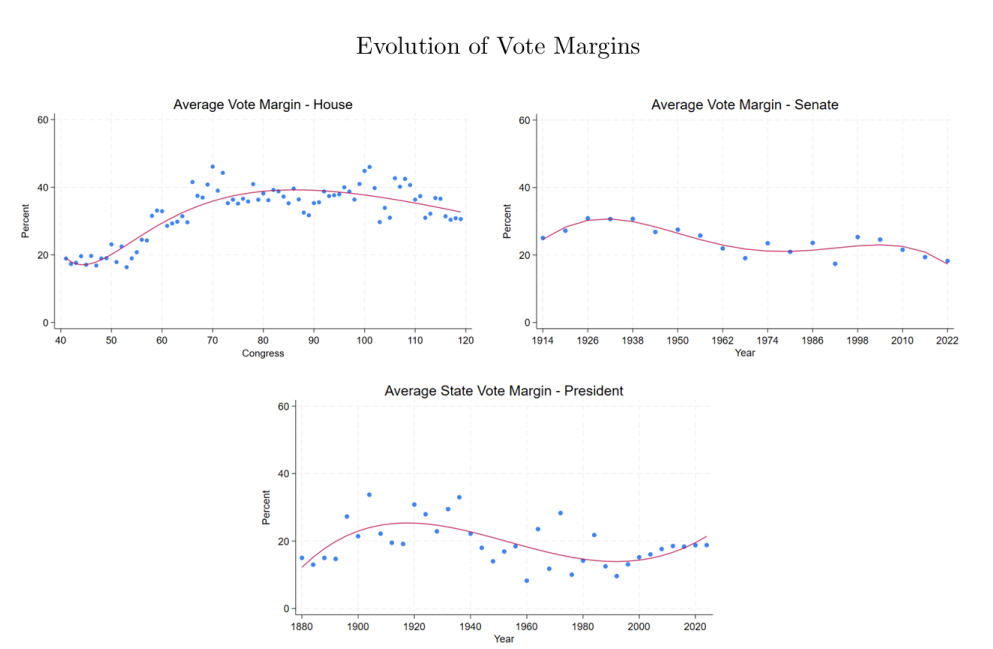
When Tricaud and Wacziarg drill down on actual vote counts at the congressional district level (for House elections) and at the state level (for Senate and presidential elections), they find persistently wide vote margins.
From 1952 to 2022, consistent district- and state-level data show most elections are far from nail-biters. House elections have been decided by an average of 34 percentage points, Senate elections by an average of 24 points and state-level presidential contests by an average of 19 points (as shown below).
To explore what may be driving the disconnect between slim margins that determine control in Washington and wide constituency-level vote margins, the researchers built a model of elections that highlights two forces drawn from prior scholarship: better targeting of pivotal voters and the nationalization of political issues.
Data Takes Over Politics
One key to understanding today’s razor-thin margins that decide power in the legislative and executive branches is the rise of modern polling and campaign analytics. Tricaud and Wacziarg draw on earlier scholarship showing how presidential campaigns increasingly rely on polling — from just 15 private polls in 1960 to over 200 by Ronald Reagan’s second term, and an exponential increase in active polling since 1984. With better data, campaigns can find and granularly pitch the pivotal median voter in swing districts.
In the model, this technology-driven boost in information about voter preferences makes national outcomes closer, as both parties compete for swing constituencies. Without modern polling, parties operate in the dark, so large margins of victory can be more frequent. With it, national parties can optimize their platforms and messages to compete for pivotal constituencies.
Nationalization of Campaigns
How then to simultaneously account for the persistence of large vote margins? In earlier decades, congressional races could hinge on concerns unique to a district — a factory closing, a new dam project or whether the incumbent showed up at the county fair. Local newspapers amplified those issues, and ticket-splitting was more common. Candidates of both parties could tailor their platforms to these local issues.
Today, local elections are decided based on national issues. Tricaud and Wacziarg note that prior research documents a decline in local media and a rise in national narratives. This makes it difficult for local candidates to deviate from the political orientation of national parties. Thus, at the local level party candidates cannot move toward the preferences of local electorates, leading to large vote margins: A Republican candidate in a blue district or state must toe the national party line and is assured to lose (and symmetrically for a Democratic candidate in a red district).
New Campaign Strategies
To provide supporting evidence of the joint increase in information and nationalization of elections, the authors turn to campaign finance. Using Federal Election Commission data from 1980 to 2020, they show that funding increasingly concentrates in a dwindling set of swing districts. Better information enables national parties to identify and target swing districts, while nationalization turns parties away from ideological districts, since there is no point in spending money in districts where the outcome is all but assured.
As long as technology enables microtargeting and politics is dominated by national narratives, Tricaud and Wacziarg’s model suggests we may remain in a system in which local races are typically decided by wide margins, national control is razor-thin and often switches between parties, and political campaigns are focused on a narrow set of districts.
Featured Faculty
-
Clemence Tricaud
Assistant Professor of Economics
-
Romain Wacziarg
Professor of Economics; Hans Hufschmid Chair in Management
About the Research
Tricaud, C.,& Wacziarg, R. (2025). Electoral Margins and Political Competition (No. w34566). National Bureau of Economic Research.