The centrist-minded are often no-shows when their parties are choosing candidates for general elections
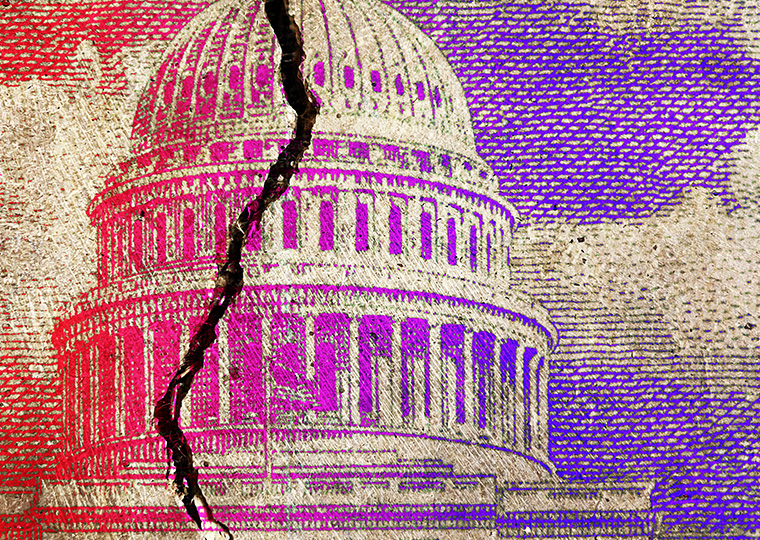
Partisanship has always been the foundation of democracy, but over the past 50 years there has been a worrisome erosion of moderation. An analysis by Pew Research found that in the 1970s, 144 House Republicans were less conservative than the most conservative Democrat, and 52 Democrats were less liberal than the most liberal Republican. By 2002 such overlap was nonexistent, effectively removing the moderate middle as a force in government.
At the same time, a majority of Americans are not happy with a government fueled by polarization. Another survey by Pew in 2025 found that 62% of Republicans and 56% of Democrats believe their own party is too extreme in its positions.
In an NBER working paper, UCLA Anderson’s Ivo Welch looks at the root causes and suggests that addressing political polarization may not require heavy-lift reforms like eliminating gerrymandering, curbing dark money or overhauling the Electoral College. Drawing on economic and voting behavior research, he builds a model suggesting that political polarization is surprisingly fragile and can be simultaneously undone across both parties with a subtle shift toward the center in one party.
For example, Welch’s model suggests a shift of just 1% in who votes in a party’s primary could be enough to trigger a sharp shift away from more extreme candidates. Moving the needle 1% seems considerably more doable than contemplating massive election-system reforms.
Purists Who Vote
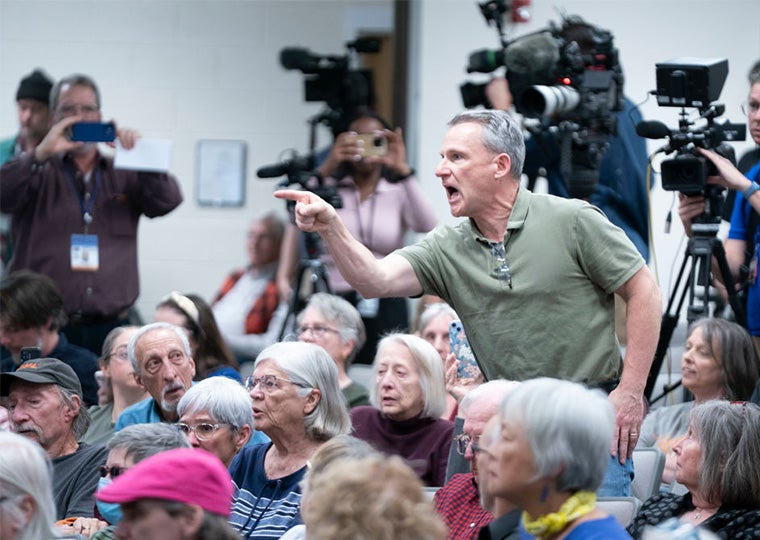
But getting that 1% shift will require breaking what Welch calls the “primary trap” that incentivizes candidates to cater to party ideologues. According to the Bipartisan Policy Center, about 80% of eligible voters don’t bother to vote in primaries. And the 20% who do show up tend to be ideological purists who are hypermotivated to have their views platformed. That turnout dynamic is not lost on candidates. They do the rational thing and aim to court the voters who actually show up, which means staking out positions at the extreme end of their party. That’s how we end up with general elections pitting two extreme-leaning candidates against each other.
Welch, in an email exchange, notes that his model captures a moment in time, a snapshot that doesn’t suggest how events might evolve. For now, employing labels partisans apply to each other: “Extremism on one side requires extremism on the other side. Woke Democrats makes MAGA possible. MAGA makes woke Democrats possible. The same environment could have one case where both parties are modest, and another where both parties are extreme — and much more extreme than voters.”
Welch’s model agrees that this trap is hard to escape — and yet why it’s also breakable. He sets up a deliberately simple structure: Two candidates per party compete in primaries, then the two winners face off in a general election. Voters choose the candidate closest to themselves ideologically. The model allows voters to turn out only for candidates close to their positions. That means when both parties run extreme candidates, moderate voters — distant from both options — are the least likely to show up, while extreme voters, closer to their candidate, turn out in force.
When a party’s primary electorate shifts even slightly toward the center, the candidate who emerges can be more moderate — and this changes everything. Moderate voters have someone worth voting for. Turnout among them rises, and that can be enough to tip the result.
Moreover, in the Welch model, extremism is a symbiotic dynamic. When one party advances a less-extreme candidate in a primary in which the general election is expected to be competitive, that candidate is likely to defeat the opposing party’s extremist — precisely because more moderate voters from both sides now have a reason to show up.
The moderation by one party means that the other party recognizes that running an extremist is no longer viable. Without an extreme opponent to run against, there is no longer a general election to be won by playing to the base. The incentive to stay extreme disappears. It still wins the primary, but this is now useless because it will always lose the general election. Welch calls this interparty dynamic “moderation export.”
This isn’t limited to presidential races or Congress. The same logic applies in statehouses, school boards and local elections — anywhere the general election is competitive enough that a more moderate candidate has a structural advantage in the general election.
What makes the model striking is how little it takes to tip the balance in either direction. A small increase in voter polarization can push both parties toward more extreme positions, locking them into a cycle of division.The system is fragile in both directions.
While Welch’s model highlights a theoretical path to moderation, the current election landscape obviously presents real headwinds. Donor networks often reward ideological purity, the media environment amplifies conflict, and gerrymandered districts ensure that many elections are decided in primaries, where extremism is incentivized rather than discouraged. While Welch’s model highlights the fragility of polarization, it doesn’t fully account for these forces, nor does it address which specific races might achieve moderation — or when.
But Welch highlights several structural election reforms that could help accelerate the moderation dynamic described in his model. Open primaries, which allow any registered voter to participate regardless of party affiliation, can sometimes make it more difficult for ideological purists to dominate outcomes. Similarly, ranked-choice voting, which incentivizes candidates to appeal to a broader base, could reshape who emerges victorious in primaries.
For voters disillusioned by political extremism, Welch’s model offers a surprising glimmer of hope: Even a modest shift in a primary electorate toward the center has the potential to spark a chain reaction, drawing candidates from both parties away from the extremes.
Featured Faculty
-
Ivo Welch
Distinguished Professor of Finance; J. Fred Weston Chair in Finance
About the Research
Welch, I. (2026). Mutual Party Extremism (No. w34967). National Bureau of Economic Research.