With help, they can connect to their much older future selves, which aids in moderating today’s behavior
When you’re 14, 18, even 24 years old, weighing how a decision made today might shape your life decades from now is a tall order, especially given that your brain’s capacity for long-term thinking is still a work in progress.
And it’s not as if age magically brings an intuitive ability for thinking about our future selves. UCLA Anderson’s Hal E. Hershfield specializes in studying how we perceive and relate to our older selves. As he explains in his book, Your Future Self, we often regard our distant older selves almost as strangers, which can make it harder to choose behaviors today — save more, overindulge less — that may benefit us decades from now.
In a chapter for the forthcoming Handbook of Motivation and Social Psychology, Stanford’s Peggy Yin, a Ph.D. candidate, and Hershfield trace how adolescents become aware of, connect with, and actively shape their future selves — and how this process can be supported to help them make better long-term decisions.
Their survey of decades of interdisciplinary research pushes back against the familiar stereotype of the adolescent as a moody, myopic hot mess focused on short-term desires.
Yin and Hershfield’s take is essentially “yes, and.” Yes, adolescent brains are still developing in areas tied to long-term thinking. And, under the right conditions, young people can be better at imagining and acting on behalf of their future selves than we often assume. Importantly, the chapter argues there’s a lot the adult world — through families, schools, culture and technology — can do to help adolescents build a stronger, more motivating connection to who they’ll become.
That matters because adolescence brings a firehose of increasingly consequential decisions, in which checking in with one’s future self could offer useful perspective, especially as more young people turn to chatbots for life advice.
Beyond the Here and Now
Yin and Hershfield’s review leads them to a four-part framework (see below) for understanding how adolescents come to know and connect with their future selves —and eventually use those future selves to help guide decisions today.
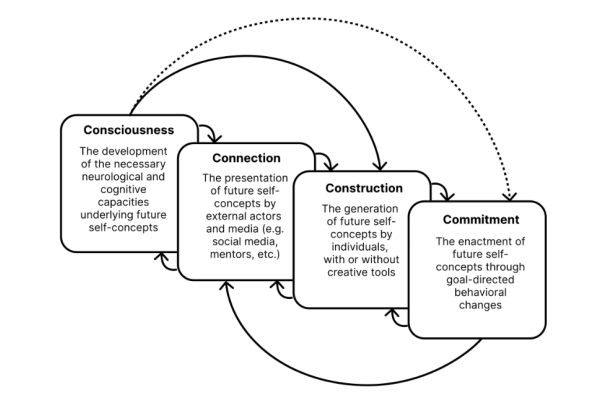
The authors stress that this isn’t a linear process that always starts with consciousness and always ends with commitment. Any given adolescent — defined here as ages 10 to 24 — may move through all four stages, skip or revisit some, or blend them together.
What is consistent is that during these highly impressionable years, it’s common for adolescents to look for outside cues. Parents, mentors, teachers and, yes, social media and pop culture all help shape an adolescent’s sense of their possible futures.
Yin and Hershfield suggest adolescents’ sense of their future selves is “limited less by biology or time than by social expectations.”
Looking Outward for Ideas
For all the rebelliousness associated with adolescents, research finds that when they imagine their future, they’re also sponges. In a landmark study, more than 10,000 British children born in the late 1950s wrote essays at age 11 imagining their lives at 25. Social factors — like their parents’ occupations — strongly shaped whether they pictured themselves going on to higher education, and what they expected their finances, family lives and daily responsibilities to look like.
And those early visions mattered. Follow-up research published in 2024 found that what these children imagined for their education and income at age 11 had a significant bearing on where they actually ended up as adults.
Influences extend beyond the home. Research has found that television characters can inspire adolescents to pursue professions they see on screen and shape their ideas about who typically does those jobs. And when researchers asked 9- to 15-year-olds to tell stories about their pasts and futures, their imagined futures stuck more closely to cultural norms than their accounts of things that had actually happened to them.
Making More Futures Possible
If the world around adolescents can narrow the future they imagine, changing what they see can also widen it. That might mean encouraging cultural heavyweights — film, television and online influencers — to showcase a broader and more vivid range of possibilities.
Yin and Hershfield also point to research showing that even small interventions can help adolescents see themselves differently. For example, in one experiment, female undergraduates who read that computer science majors no longer fit the old stereotype of socially awkward guys expressed more interest in majoring in computer science than those who read that the stereotype still held.
Other interventions make a distant future self more personal. For example, high school students who wrote a letter to their future selves — and then wrote back from the perspective of those future selves — showed bigger gains in future-self connection, career planning and willingness to delay gratification for schoolwork than students who only wrote a letter to their future self.
Technology can also help forge a more vivid connection. In two related studies Yin and Hershfield collaborated on, participants ages 18 to 30 chatted with an AI-generated older version of themselves using a tool called FutureYou. After just one session, they reported less anxiety and a stronger connection to their future selves.
Seeing a Path From Here to There
Just being able to picture your future self doesn’t automatically make it easy to figure out what choices today will help you become that person. That’s where research on “mental contrasting” comes in. Instead of only imagining a desirable future, mental contrasting asks people to also think about the obstacles that stand between them and that future. This approach helps make the path forward more realistic and actionable.
Research found that adolescents who practiced mental contrasting — by picturing their goals and then identifying what might get in the way — earned higher grades than students who were simply told to imagine a positive future.
A program called School-to-Jobs offers adolescents a path. Over several sessions, eighth graders imagined who they wanted to be in the near and distant future. They then linked those possible selves to concrete strategies for getting there, and learned that difficulty and obstacles are a normal part of pursuing a goal. Students who participated in the program had better grades, attendance and classroom behavior, and reported less depression. These gains lasted for at least two years.
Yin and Hershfield are careful not to oversell the research. A stronger connection to a future self doesn’t always translate into action, and there’s still much to learn about which interventions work best, for whom, and at what point in adolescence. But their larger point is that helping adolescents make better decisions about their futures isn’t just a matter of telling them to think further ahead.
The people, institutions and culture around them help determine which futures they can even imagine. Helping adolescents see more possibilities is a start. Helping them recognize themselves in those possibilities gets them further. And helping them see a realistic path from who they are today to who they might become may give them something even more powerful: the motivation and confidence to make it happen.
Featured Faculty
-
Hal Hershfield
Professor of Marketing and Behavioral Decision Making
About the Research
Yin, P., & Hershfield, H.E. (forthcoming). The Development of Future-Self Concepts in Adolescence. Handbook of Motivation and Social Psychology.