Foundational research broadened the conversation from intentional deception to include outcomes of external pressures, organizational systems, and human bias
Why would a company make an environmental claim it cannot support in a market full of people eager to check?
The intuitive answer is that someone decided to lie. Fifteen years ago, two researchers at UCLA Anderson argued that such an explanation was usually wrong, and that being wrong about it was making the problem harder to solve.

In “The Drivers of Greenwashing,” published in California Management Review in 2011, Magali A. Delmas and Vanessa Cuerel Burbano, then a Ph.D. student, treated greenwashing not as a moral failure but as an outcome with identifiable causes.
Weak and uncertain regulation makes an unsupported claim cheap. Siloed organizations let the marketing department get ahead of what operations can deliver. Ordinary human optimism finishes the job. A firm can arrive at a misleading claim without a single person in it having decided to mislead. (See accompanying article: “Greenwashing: A Short History of a Big Problem,” for examples of alleged misrepresentations.)
That move, from accusation to diagnosis, is why the paper is now the most cited work in its field, with more than 6,400 citations, and why its four-square typology (see below) became the instrument other researchers use to sort firms. It is also why, 15 years on, the paper reads like a specification for the disclosure rules Europe is now writing and the United States is now dismantling.
Today, Delmas is a strategy professor at UCLA Anderson and the Institute of the Environment and Sustainability at UCLA. Burbano is an associate professor at Columbia’s business school. And both are deeply engaged in ongoing research around the accuracy and utility of corporate disclosures concerning climate change.
Their paper remains a cornerstone of greenwashing research. A 2025 article in Review of Managerial Science analyzed nearly 100 papers in which greenwashing was a central theme and ranked them by citations to avoid penalizing newer work. “The Drivers of Greenwashing” ranked first. Delmas and Burbano’s elevation of the need to address regulation is echoed in recent legislation in the EU and U.K.; they also identified the ongoing issue of third-party ESG rating companies taking corporate disclosure at its word and how that may be abetting greenwashing.
Simple Grid, Complex Problem
Delmas and Burbano introduced a two-by-two framework that has since become the standard way of sorting firms by what they do and what they say about it.
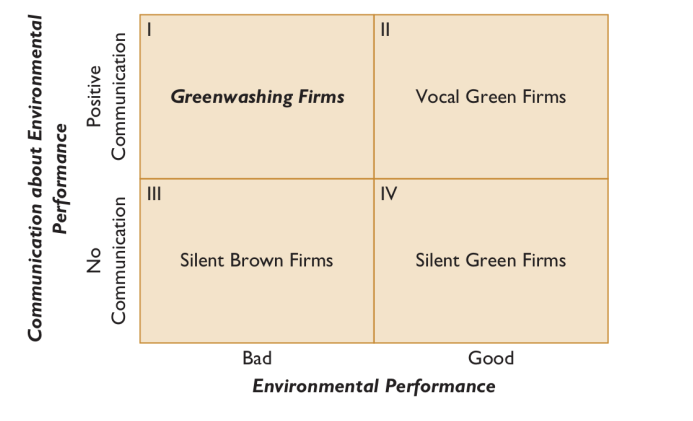
The matrix sorts firms along axes: environmental performance and environmental communication. A key nuance Delmas and Burbano introduce in defining greenwashing is that two conditions must be present simultaneously: poor environmental performance and positive communication about that performance.
The upper left is where the greenwashers live: weak environmental performance paired with strong environmental claims. The upper right holds the vocal green firms that are walking the walk and talking about it. The lower left contains the silent brown firms, neither performing well nor claiming to. And the lower right is the silent green firms: good environmental performance yet little said about it.
Why would firms under-claim? In 2011, the lower right box seemed the least interesting on the grid. Now, it’s the most topical. Firms mute real achievement to avoid litigation over claims, shareholder pushback over the expense or a place on an enemies list of someone influential with the Trump administration. The behavior got its name about a decade later: greenhushing. The framework had drawn the box before the practice had one.
In a simple but profound four-square rendering, Delmas and Burbano converted greenwashing from an amorphous accusation into a precisely defined outcome. Because the definition rests on two observable things, performance and communication, rather than on intent, later researchers could measure it: Studies comparing what firms disclose with independent performance data are populating the four quadrants.
Three Roads to the Upper Left Quadrant
Delmas and Burbano then turned to laying out a three-part thesis for how firms can land in the greenwashing quadrant.
External factors: Pressure from regulators, NGOs and markets can reward the appearance of greenness that is not backed up by actual advances in reducing the environmental footprint of a good or service. Consumer and investor demand for green products and firms gives brown firms a powerful incentive to communicate positively about their environmental performance. Delmas and Burbano stress the central role of regulation. Formal rules that require green claims made in financial disclosures, marketing and advertising be verified is a vital mechanism that can reduce greenwashing. In the absence of such regulation, the road to the upper left quadrant is wide open.
Organizational factors: This driver grew out of a 2008 Strategic Management Journal paper with Harvard’s Michael Toffel, in which Delmas showed that external pressure does not act on a company that is a monolith; it is channeled through departments, and different departments hear different things. The 2011 paper carried that insight to its uncomfortable conclusion: The department that talks and the department that delivers can drift apart without anyone intending it. For example, marketing talking up green initiatives when operations is still trying to figure out what it can pull off. Incentive structures and the ethical climate of a firm also play a role. Delmas and Burbano also point to organizational inertia as a culprit. A CEO can lay down environmental commitments as a priority, but that doesn’t magically mean the organization has the structure and processes to deliver.
Individual factors: The same behavioral quirks that we are now aware impact our personal choices are also at play at work. Optimism bias, the tendency to make choices in isolation without considering downstream consequences, and our tendency to underweight future costs can all lead executives and their direct reports to talk the talk regardless of whether the firm is actually walking the walk.
Delmas and Burbano draw a careful distinction between intentional deception and self-deception. Executives who genuinely believe their own optimistic environmental narrative, and communicate that belief externally, are not lying in the conventional sense — but the result is misleading all the same.
Delmas and Burbano argue that lax regulation doesn’t just enable greenwashing directly — it amplifies all three drivers. When enforcement is uncertain and disclosure is voluntary, organizational pressure to align incentives and communication is weak, and individual cognitive biases face fewer external checks. In the absence of formal regulation, the burden falls on NGOs and market actors to serve as informal monitors.
Mouthpiece Vs. Drainpipe
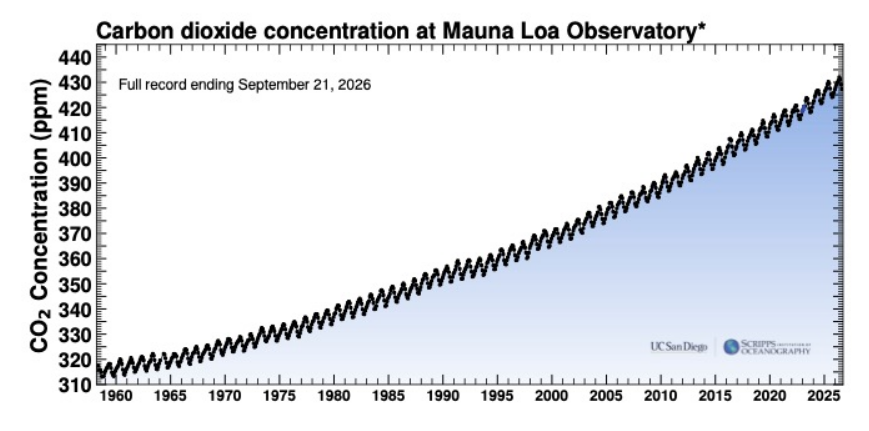
In the years following Delmas and Burbano’s 2011 paper, against a backdrop of rising greenhouse gas concentration and growing signs of global weather disruptions, they and others sorted through a maze of corporate claims and actual performance, bit by bit doing the work government hadn’t shouldered. Read in sequence, her later work asks why the gap persists: Something fails to catch firms, something pays them to talk rather than act, and someone must eventually do the verifying.
A 2016 study published in Organization Science advances this theoretical framework with a real world analysis. Cornell’s Christopher Marquis, Harvard’s Michael Toffel, and Peking University’s Yanhua Zhou tracked the environmental reporting of 4,750 public companies across 45 countries over four years, comparing what companies disclosed with independent measures of their actual environmental performance.
Their central finding seems counterintuitive: The worst environmental performers, particularly those operating in countries with strong regulatory and civil society oversight, were actually less likely to engage in selective disclosure than moderate performers. But it dovetails with the role of oversight in the Delmas-Burbano framework: Heavy scrutiny, it turns out, can push the most egregious actors toward greater candor — a direct empirical confirmation of the 2011 paper’s core argument that strong regulatory environments can reduce greenwashing. That point is amplified by a complementary finding: Among companies facing only moderate public scrutiny, disclosure remained systematically skewed toward positive information.
A 2015 review article in Organization & Environment by University of Michigan’s Thomas Lyon and Wilfrid Laurier University’s A. Wren Montgomery reaches a consistent conclusion. Greenwashing is not simply a matter of firms making false claims, but a predictable response to competing pressures — strong incentives to appear environmentally responsible paired with weaker incentives or limited ability to improve performance. In that sense, the paper confirms a central thesis of Delmas and Burbano: Greenwashing is less about intent than about the conditions firms operate under.
Do We Reward Process or Results?
The 2011 framework anticipated a problem that has dogged ESG investing throughout its evolution. When claims are hard to verify and regulation is weak, Delmas and Burbano argued, companies have little incentive to back up green signals with real action. This plays out in ESG ratings, which typically rely on company disclosures and too often take them at face value.
In a 2013 Academy of Management Perspectives paper, Delmas collaborated with McGill’s Dror Etzion and UCLA’s Nicholas Nairn-Birch to examine what ESG ratings actually capture. They analyzed data from three major providers of ratings for 475 U.S. companies and found that about 80% of the differences are explained by two factors: what companies say they are doing to manage their environmental impact (policies, management systems, reporting), and what actually happens to the environment as a result of their operations (emissions, resource use, etc.). Processes loomed larger in ratings, accounting for 46% of the variation, and outcomes explained 33%.
The problem exposed by the researchers is that ESG ratings reward effort more than execution. It is, in a sense, the 2011 framework’s organizational driver made measurable — the gap between what a company sets up and what it actually delivers, now visible in the ratings data itself.
Moreover, Delmas and co-authors also document that investors reward process, not outcomes. Companies are valued for looking organized and committed, regardless of whether they are actually making any meaningful impact on reducing their overall environmental footprint. That suggests the incentive to greenwash is built into the financial system itself.
The Hit to Profits
In a 2015 Organization & Environment paper, Delmas and Nairn-Birch collaborated with UCLA’s Jinghui Lim to further examine the relationship between environmental performance and financial performance.
Studying greenhouse gas emissions data from 1,095 U.S. corporations between 2004 and 2008, they found that genuinely going green tends to depress return on assets in the short run — meaning managers who reduce emissions can expect a near-term hit to the bottom line. Longer-term investors, however, do see the value: The same improvements that hurt short-run returns were associated with higher market valuations of the firm’s future prospects. The finding draws a sharp picture of the trap managers face. Short-term financial targets push against real environmental investment. And if ESG ratings reward process over outcomes — as the 2013 paper showed — the market is not just tolerating that trade-off. It may be quietly rewarding it.
In the intervening years, more disclosure has not necessarily resolved that divergence; if anything, it has given companies more material to shape the narrative. This gap between disclosure and verification is exactly what Delmas is now trying to close. In 2023, she launched Open for Good within UCLA Anderson’s Center for Impact, an initiative that independently assesses the climate-related disclosures of S&P 500 companies. Its 2026 report found that while emissions disclosures have improved, fewer than a quarter of companies provide a credible transition plan showing how they intend to meet their climate targets. The issue is no longer whether firms are talking about the environment, but accountability for their actual footprint.
A 2026 study published in PLOS Climate by the University of Miami’s Maya Bach, Loredana Loy, Katharine Mach and Jennifer Jacquet, with New York University’s Sonali McDermid, suggests the gap remains quite real. The researchers examined 1,233 environmental claims drawn from the sustainability reports and websites of 33 of the world’s largest meat and dairy companies. Only 29% of the claims were supported by any evidence at all; just three were backed by peer-reviewed scientific research. Using a greenwashing assessment framework, the authors concluded that 98% of the claims could be categorized as greenwashing.
In 2023, Delmas and Burbano reunited on a paper that turned that diagnostic instinct on their own profession. With the University of Granada’s Manuel Jesus Cobo, writing in Organization & Environment, they mapped the field of corporate sustainability research across 11,954 articles published from 1994 to 2021. As climate change grew more severe, the research field drifted away from the environment, broadening into social and governance concerns while devoting strikingly little effort to measuring firms’ actual environmental effects. The researchers who diagnosed the say-do gap in companies had found a version of it in their own field.
When Regulation Advances the Ball
While there is no explicit reference or nod to “The Drivers of Greenwashing” in recent regulatory pushes to address greenwashing, its framework reads like a silent partner.
The European Union’s Sustainable Finance Disclosure Regulation took effect in 2021, requiring asset managers to spell out how sustainability claims are constructed. That was followed by the Corporate Sustainability Reporting Directive, adopted in 2022, which mandates standardized environmental disclosures from thousands of companies operating in Europe. The proposed Green Claims Directive, introduced in 2023 and still moving through the legislative process, goes further, requiring companies to substantiate environmental claims before making them. In the U.K., the Financial Conduct Authority’s anti-greenwashing rule, finalized in 2024, requires sustainability-related claims to be fair, clear and capable of substantiation.
Taken together, these measures reflect a consistent shift: Disclosure alone is no longer enough. Claims must be comparable, documented and verifiable — closely aligned with the kind of mandatory, verifiable disclosure Delmas and Burbano argued was necessary to limit greenwashing.
The United States has followed a more uneven path. The Federal Trade Commission last updated its Green Guides in 2012, with revisions proposed but not finalized as of 2024. The Securities and Exchange Commission introduced a sweeping climate disclosure proposal in 2022, only to scale it back significantly in 2024 after legal and political challenges. The current administration has since moved to roll back what remained. In the paper’s own terms, the United States is moving deeper into the lax and uncertain regulatory environment that Delmas and Burbano identified as the primary driver of greenwashing.
The exception is California, where Senate Bill 253 will require large companies doing business in the state to report verified greenhouse gas emissions starting in 2026. Delmas is working with the state’s regulators on its implementation.
Now What?
Fifteen years after the California Management Review paper, for Delmas and other researchers, particularly those in the U.S., the political moment is jarringly out of sync with the need for clarity around corporate deeds and words. The Trump administration is busy dismantling environmental policy, rewarding polluting industries and penalizing the embrace of clean energy.
And climate change has arrived with increasing violence. In the five years through 2024, U.S. data show that the nation’s biggest weather disasters caused average annual damage of roughly $150 billion and killed more than 500 Americans a year. Globally, a 2025 U.N. report estimates annual losses now exceed $2 trillion, with more than 40,000 deaths linked to climate-related disasters. Having made grand promises, corporate credibility around environmental claims is shot.
As a bookend to the earlier paper, in a 2026 Academy of Management Perspectives article, Delmas along with UCLA Anderson’s Dylan Minor and UCLA Institute of the Environment and Sustainability’s Kelly Clark and Tyson Timmer, builds a guide for companies on how to restore credibility. Overpromising and oversimplification are out.
The paper tackles the problem of poor-quality corporate disclosure, including greenwashing, by identifying — and insisting corporations call out — the two forms of uncertainty that undermine accurate disclosure: effect uncertainty (does the action actually produce the intended outcome?) and measurement uncertainty (can the outcome be accurately and consistently quantified?).
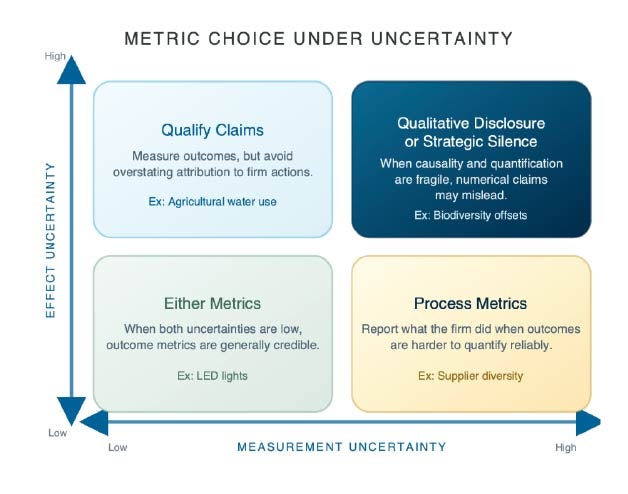
Again, there’s a helpful matrix.
- If both effect and measurement uncertainties are low, say for an energy efficiency upgrade with precise utility meters and predictable savings, outcome metrics are credible.
- If measurement is uncertain, metrics around process — reporting what steps the firm took — are better.
- If effect uncertainty is high, but measurement uncertainty is low, company claims should be qualified. Here’s the positive impact we’ve observed, but we can’t claim our actions are responsible for all of that.
- If both uncertainties are high, publishing a number isn’t just imprecise — it may be misleading.
Transparency, the authors argue, is necessary but not sufficient. What stakeholders are owed — and what markets ultimately require — is credibility: claims that are not just disclosed, but defensible. Fifteen years after Delmas and Burbano first mapped the terrain, that remains the unfinished work.
Greenwashing: A Brief History of a Big Problem
It started with a hotel towel. In 1983, Jay Westerveld was surfing in Fiji and snuck into a fancy resort to steal some clean towels. As he recounted to The Guardian, he found a card urging guests to reuse towels to protect the island’s coral reefs — while the resort was simultaneously expanding along that same coastline. In a 1986 essay he reflected on that irony, coining the term “greenwashing” to describe environmental virtue signalling that belies profit-seeking policies that are not at all green.
Fast forward to today and claims of greenwashing are increasingly the focus of legal and regulatory scrutiny. Some recent greenwashing cases:
JBS (United States, 2024-2025)
New York sued the world’s largest meat processor over its “net zero by 2040” pledge, arguing the company lacked a credible plan and was expanding production. The case settled in 2025: JBS agreed to pay $1.1 million to fund climate-smart agriculture, reform its environmental marketing and subject its claims to oversight. As part of the settlement, the company must frame its 2040 target as a “goal” rather than a firm commitment.
Shell (United Kingdom, 2023)
The U.K.’s Advertising Standards Authority banned Shell ads promoting cleaner energy activities — wind power, EV chargepoints, #PoweringProgress — while omitting fossil fuel operations that represented more than 95% of its business. The ruling warned Shell not to exaggerate the role of low-carbon energy in its portfolio and set a precedent for fossil fuel advertising standards in the U.K.
KLM (Netherlands, 2024)
In the first greenwashing ruling against any airline worldwide, Amsterdam’s District Court found 15 of 19 claims in KLM’s “Fly Responsibly” campaign misleading and illegal under EU consumer law. The court ruled that claims about sustainable aviation fuels and carbon offsets painted an unrealistically optimistic picture and that KLM’s stated commitment to Paris Agreement goals was unsubstantiated.
DWS/Deutsche Bank (Germany, 2021-2025)
Deutsche Bank’s asset management arm DWS was investigated after a 2021 whistleblower alleged it systematically overstated its ESG credentials. German authorities raided Deutsche Bank’s Frankfurt offices in 2022. DWS was fined €25 million in April 2025. (DWS also settled a related case with the SEC for $19 million.)
Keurig (2022-present)
The coffee-pod behemoth promoted its K-Cups as recyclable, without noting that many municipalities lacked the capacity to process them. A U.S. class action led to a $10 million settlement in 2022. Canadian regulators also fined Keurig Canada and required environmental remediation payments. A U.S. federal class action lawsuit produced a $10 million settlement in 2022. In 2022 the Canadian government extracted a $3 million penalty (CAD) and ordered Keurig Canada to donate $800,000 to an environmental charity. Additional suits are pending.
Featured Faculty
-
Magali Delmas
Professor of Management; Faculty Director, Impact@Anderson