Rather than sell stock, they shift capital from other units to banks, satisfying the letter of the law, if not its spirit
Making sure banks have more capital on hand to absorb losses is one of the enduring structural changes that followed the 2008 financial crisis, when massive federal intervention was needed to keep the banking system functioning.
Basel III, a global banking framework that went into effect in the U.S. in 2015, significantly raised the amount of equity regulated banks must hold to absorb potential losses.
By many measures, banks are indeed safer. But the Federal Reserve Bank of New York’s Nicola Cetorelli and UCLA Anderson’s Shohini Kundu, in a working paper, suggest that those bank-level safety gains are an incomplete measure of whether the broader banking organization is better positioned to weather extreme market stress.
Their paper shows that the structure of many banks allows them to meet Basel III requirements without necessarily improving the overall capital cushion of the parent company.
Their research focuses on how what we view simply as a bank — JPMorgan Chase, Bank of America, Citigroup and Wells Fargo being the biggest examples — is actually a bank holding company made up of subsidiaries subject to very different regulatory requirements.
While some subsidiaries must follow strict Basel III capital rules, others, such as broker-dealers and consumer lending arms, do not fall under the same oversight.
Past research on how money moves among subsidiaries of bank holding companies has focused mostly on how cash, loans and deposits are shifted between affiliates to cover immediate funding needs. Cetorelli and Kundu show that’s not where the real action is. When a bank holding company parent puts money into its bank subsidiaries, it does so overwhelmingly in the form of equity, rather than loans or cash advances. The researchers calculate that these equity transfers are about 10 times larger than other types of internal funding.
That distinction matters because regulators count equity (very roughly, proceeds of stock issuance and retained earnings), not cash, as the key buffer that absorbs losses in a crisis. Also, nonbank subsidiaries tend to hold a lot of equity relative to their size, typically measured in assets (loans and other instruments), making them a convenient reservoir for holding companies to tap into to boost the capital of their regulated banks.
And that’s what Cetorelli and Kundu expose. Rather than go the expensive route of raising new capital, through the sale of shares, to meet Basel III requirements, the authors document that holding companies play a version of borrowing from Peter to pay Paul: They move equity from nonbank subsidiaries exempt from Basel III to the bank subsidiaries that must meet it. After Basel III, bank subsidiaries report 5-8 percentage points more excess capital.
The authors term these transfers “regulatory arbitrage.”
Selling a lot of new stock to boost capital, it should be noted, dilutes the ownership of existing shareholders, including executives. In some regards, doing so is seen as a sign of weakness.
On paper, that satisfies regulators, as the holding companies can show that regulated subsidiaries are meeting Basel III requirements. But the reshuffling — siphoning equity from lesser- or unregulated affiliates — weakens the capital position of those nonbank subsidiaries.
The researchers also find that holding companies squeeze their nonbank subsidiaries in other ways. After Basel III, holding companies extract nearly 10 percentage points more in dividends from nonbank subsidiaries, while bank subsidiary dividends remain unchanged. The companies also increase the interest rates charged to nonbank subsidiaries for internal funding by about 3 percentage points, making it more expensive for nonbanks to access cash from the parent. These moves further drain nonbank affiliates in order to support the regulated banks
The net effect is that the overall capital position of the bank holding company does not improve, confirming that the extra capital in the banks comes from the nonbank side rather than from new capital added to the organization.
Capital is not just a cushion. As a measure — assets minus liabilities — a high capital ratio means a bank or nonbank affiliate has more assets earning a return than liabilities requiring interest be paid out, which boosts profits. So, lowering the capital ratios has a business impact. And these units have managers looking to make a bonus and overseers demanding profits.
Thus, with weakened balance sheets, Cetorelli and Kundu show, nonbank subsidiaries have shifted toward riskier consumer loans that can generate more revenue, while reducing their investment in commercial loans.
If Those Nonbank Subsidiaries Run Into Trouble?
Holding companies are not legally required to bail out a troubled nonbank subsidiary, and nonbank affiliates typically do not have federal backstops such as deposit insurance. But Cetorelli and Kundu note there is often a market expectation that the parent will step up if needed, driven by reputational concerns, market pressures and the risk of broader financial contagion.
That implicit expectation makes the perceived gains from Basel III less robust. The researchers ran a stress test modeled on 2008-scale losses to estimate what would happen if nonbank subsidiaries ran into trouble and their holding company parent stepped in to help.
On average, covering nonbank subsidiary losses in a crisis would use about 18% of the excess capital held by holding companies — not catastrophic, but not reassuring either.
Excess capital? That’s roughly capital on hand over-and-above regulatory requirements and is a closely followed measure of strength to regulators, investors, institutional depositors and trading partners.
For most bank holding companies, under the stress test model of the paper, the buffer would be reduced but not eliminated. But for the most vulnerable 4% to 6% of holding companies, a 2008-level crisis would be severe enough to wipe out all their excess capital.
“While the majority of (bank holding companies) retain some buffer capacity, the 4%-6% depletion rate suggests meaningful systemic fragility,” they write. “During crisis episodes when correlated shocks affect multiple BHCs simultaneously, many large financial institutions may be forced to liquidate assets, cut credit or raise emergency capital under adverse market conditions.”
Looking at the Whole Pie, Not Just the Regulated Slices
The researchers built a data set covering 2010 through 2024, spanning the years before and after Basel III took effect in the United States. By using required federal quarterly regulatory reports filed by both banks and their nonbank subsidiaries, they could follow how money and capital moved around inside these complex organizations.
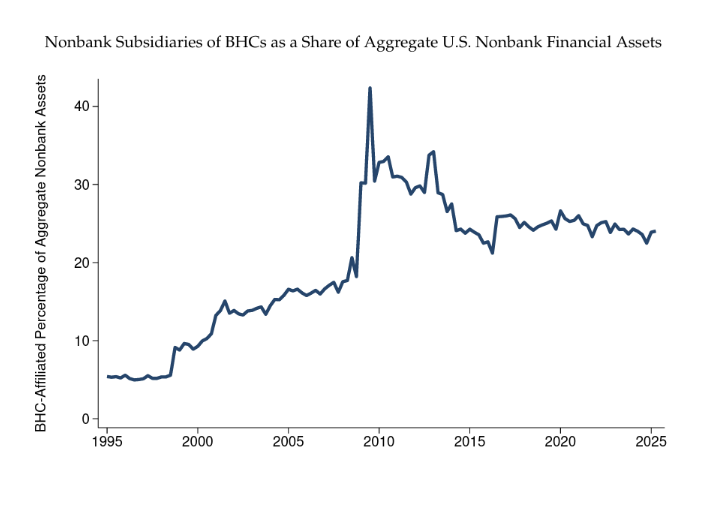
Cetorelli and Kundu observe that nonbank subsidiaries are far from a niche corner of the banking system. Nearly half of all bank holding companies in their full sample hold at least one nonbank subsidiary. Among the larger, more complex holding companies that have been around since before 1994, and are most likely to be considered too big to fail, that share rises to 57%. Smaller holding companies are also likely to have nonbank arms: Among those with $1 billion to $10 billion in assets, 64% run at least one nonbank subsidiary.
By the researchers’ estimate, around 25% of all assets held by U.S. nonbanks sit inside a bank holding company. Nonbank subsidiaries, in other words, are not some fintech sideshow. They are often a structural feature of traditional banking organizations.
That scale is why the subsidiary-level view matters. Bank subsidiaries inside holding companies with nonbank affiliates roughly doubled their retained earnings (a key component of capital), from about 5% to 10% of assets, between 2015 and 2020. Banks without nonbank subsidiaries stayed flat near 5%. None of this looks unusual on its own — it’s only visible as a pattern once both sides of the bank holding company are examined together.
That, Cetorelli and Kundu suggest, is the broader lesson — one that extends well beyond banking. Any organization with multiple moving parts that fall under different oversight can produce the same potentially dangerous unintended consequence: Regulatory requirements can be met without fulfilling the underlying goal of those regulations. “Organizational structure is a fundamental determinant of regulatory outcomes,” they write.
Featured Faculty
-
Shohini Kundu
Assistant Professor of Finance
About the Research
Cetorelli, N., & Kundu, S. (2026). Regulatory Arbitrage Within the Firm.