You as a customer can control two factors — time of day and whether you insist on personally accepting the goods — but not the third, route density
Your groceries are bagged and waiting to be picked up by a delivery driver, but your order sits unclaimed in the app. You even offered a big tip to your order, yet a less-generous customer had his stuff picked up by a driver in seconds. What gives? Somewhere, a gig worker glanced at both offers and selected one based on more than just the money.
That gig worker’s order decision is the subject of research forthcoming in the Journal of Operations Management. Miami University’s Nicolò Masorgo, Auburn’s David D. Dobrzykowski, UCLA Anderson’s Christopher S. Tang and University of Arkansas’ Brian S. Fugate authored the study, analyzing nearly 2 million crowdshipping tasks from a grocery retailer’s platform.
The authors find that higher pay does, in fact, speed up task acceptance by delivery drivers, but with diminishing returns. What appears to matter just as much are the features of the task. That includes the route design (number of orders and total distance), customer contact (whether the delivery requires interaction like a signature) and the time of day. Each of these variables influences driver behavior in ways that go far beyond a simple one-dollar increase in tip.
As the researchers put it: “There is more to crowdshipping than money in determining engagement.”
Data From a Grocery Chain
And the stakes come down to more than just melted ice cream. The final leg of a product’s journey, the so-called last mile, eats up an estimated 30%-35% of logistics costs, and companies have been tripping over it ever since Webvan flamed out trying to crack grocery delivery in the dot-com era. At the same time, the math is growing harder as subscription services lock in fixed customer fees (like Amazon Prime) while delivery costs continue to climb. Uber Eats is probably the most well-known example of crowdshipping in which independent drivers choose delivery jobs off the app. Grocery chains also operate delivery services using gig drivers.
The researchers’ data comes from a U.S. Fortune 100 grocery retailer’s platform. The dataset includes time stamps, driver remuneration broken down by pre-tipping and total compensation, the number of orders in a delivery task for which the driver did not need to interact with the customer, driver ID and the coordinates of each drop-off location. It covers the period from February 2022 through April 2022, and the researchers added store IDs, store addresses and task travel distances to the data.
This model of work attracted 59 million American workers in 2021, but it has a soft spot. As independent gig workers, drivers can ignore any task they dislike, and this can lead to slow task acceptance, which threatens a retailer’s service levels. A common fix to the problem is handing out monetary incentives through surge pricing, but it’s an expensive and unreliable method. Some drivers dodge surges entirely, to avoid dealing with a flood of competing drivers. And at higher pay levels, monetary incentives become less effective.
Masorgo, Dobrzykowski, Tang and Fugate argue there’s a smarter approach hiding inside the job itself.
Time Is Money
Using the data they collected, the authors tracked how quickly drivers accepted each task after it appeared on their mobile app. A metric was created for this called acceptance response time, or ART. A lower number means faster acceptance, which can mean smoother and potentially cheaper operations. Analyzing tasks completed in the dataset, the researchers mapped how pay, route density (how many deliveries were packed into each mile), delivery type (whether stops required customer contact or deliveries could be left unattended) and time of day each shifted that clock.
While higher pay does, on average, lead to tasks being accepted faster, it’s not a linear relationship. ART falls steeply at low pay levels and then flattens out as pay rises. Think of it like the first cup of coffee in the morning. It can provide a big, helpful jolt. But then the second cup has less impact. A $4 increase to a $10 task, the estimates suggest, will cut acceptance time by roughly 10%. But that same $4 added to a $50 task trims it by only about 5%. Money buys progressively less speed at higher pay levels.
That’s a pattern consistent with prospect theory, which suggests that initial gains matter more than later ones. The response-to-pay curvature matters even more once you layer in what else drivers are weighing.
Route density turns out to be a powerful amplifier. A dense route, say, nine stops delivered within 6 miles, is a more efficient machine for earning money. It requires less driving and more dropping off. When routes are tight and efficient, estimates indicate drivers respond sharply to even modest pay, snapping up tasks quickly. When it comes to sparse routes, that same dollar increase does far less work. “While pay is a key factor in engaging gig-economy drivers,” the researchers explain, “platform managers can leverage delivery operational characteristics to more efficiently motivate task acceptance.”
Uncertainty of a Personal Handoff
The model estimates imply that increasing pay from roughly $7 to $45 reduces acceptance time by about 50% for a low-density route (two orders across 16 miles), but by as much as 70% for a high-density one (nine orders across 6 miles). So, improving routing can squeeze considerably more engagement out of the same pay budget.
The type of delivery adds another dimension. On average, about 89% of the dataset’s orders within a delivery task were unattended — drivers leave orders at the door with no customer interaction. These tasks carry predictable effort. When tasks skew heavily unattended, estimates suggest drivers become more responsive to incremental pay, with smaller bumps moving the needle further.
Attended deliveries, where a customer must be home to receive an order, introduce genuine uncertainty into the encounter, and drivers appear to price that uncertainty in. A fully attended task, the estimates indicate, requires about $2 more in additional pay to achieve the same 20% reduction in acceptance time as a fully unattended one.
Drivers Are People
Then there’s the problem around evenings. Daytime tasks follow a clean diminishing-returns curve. Evening tasks break the pattern. Deliveries in the evenings are accepted more slowly to begin with and pay becomes a blunter tool — platforms must keep raising it in larger increments just to maintain the same engagement gains.
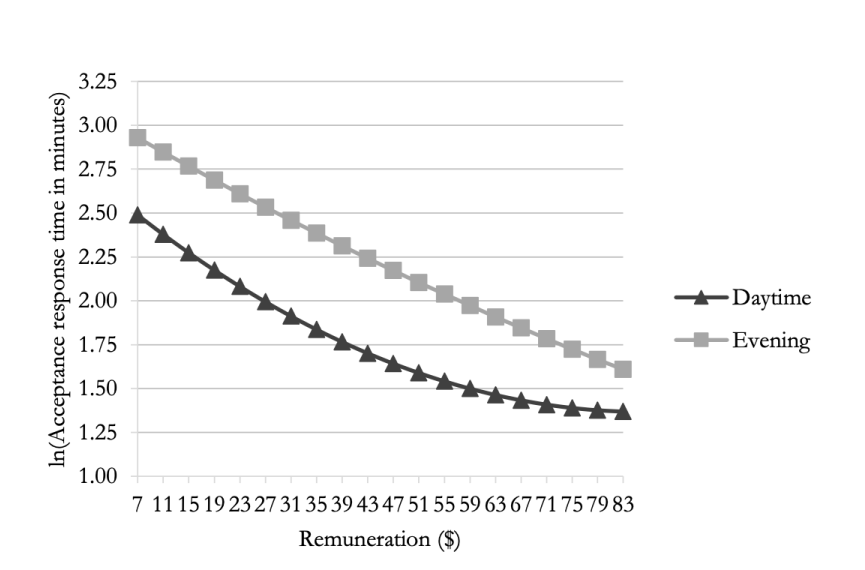
The explanation lands on something systems designers mightn’t have prioritized: life. Evening hours compete with dinner and family time, or just leisure. Fatigue accumulates through the day. Safety concerns tick up after dark. Gig workers chose this kind of work partly for schedule flexibility, and evening hours are precisely the hours they guard most fiercely. A follow-up analysis in the study finds a useful countermeasure. Dense, efficient evening routes are accepted faster than sparse ones, even without extra pay.
There were some constraints to the study. All data come from a single retailer over three months in early 2022. This window of time misses holiday surges and seasonal swings. Also, only completed tasks were observed, not rejected ones. And because the researchers inferred driver motivations from behavioral patterns rather than direct interviews, the inner workings of those split-second decisions remain partially in the dark.
Still, the findings reframe a costly assumption. Platforms have long treated sluggish driver engagement as a compensation problem, solved by steadily raising what’s paid. What this research suggests is that there are opportunities to more intelligently design tasks. It’s a reminder that gig drivers are running a continuous calculation about whether a particular task is worth their time at a particular moment. Platforms that learn to speak that language may find they need far fewer dollars to hold a conversation.
Featured Faculty
-
Christopher Tang
Distinguished Professor Emeritus
About the Research
Masorgo, N., Dobrzykowski, D. D., Tang, C. S., & Fugate, B. S. (2026). There Is More to Crowdshipping Than Money: Understanding How Operational Characteristics Influence Driver Behaviors. Journal of Operations Management.