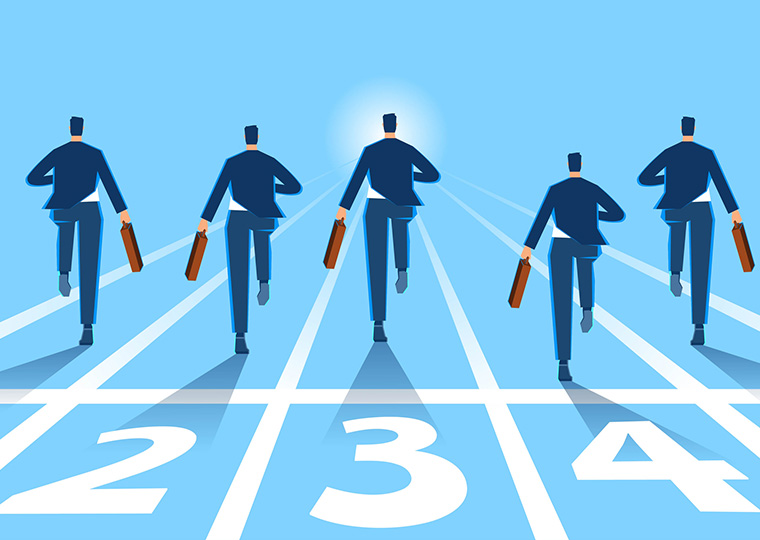
Promise of productivity gains can set off a rat race among workers
In a recent survey of nearly 3,900 full-time U.S. workers, more than 90% of people who said they use AI daily at work said it makes them more productive on the job. Seemingly at a cost. “The most productive AI users carry a burnout risk 4.5 times higher than their peers,” the study authors at WebMD reported. “The very employees delivering the greatest productivity gains through AI are simultaneously the most vulnerable to burnout.”
A working paper by UCLA Anderson’s Auyon Siddiq provides a theoretical underpinning for that burnout fear, introducing a model — built on game theory — that explores how productivity-boosting technology like AI changes the workplace dynamic.
In Siddiq’s model, employees decide how hard to work, knowing that better technology makes each hour count for more, and that pushing themselves harder increases their burnout risk. And crucially, workers know their pay depends, at least in part, on how they stack up against their co-workers.
These conditions always exist on the job, of course, but the introduction of a major new work tool — and the sometimes over-the-top management expectations that accompany it — can make it seem like everything is newly up for grabs. What’s more, workplace pressure with AI is turbocharged by the widespread knowledge that, to many company leaders, success with the technology is measured by how many workers are made redundant.
Forced Ranking
Siddiq’s model, which includes the fact that high-tech tools indeed can drive greater risk of burnout, suggests that the culprit might be less the technology and more how management chooses to measure and reward employees.
Many companies use a kind of scoreboard that ranks employees against each other on productivity and other performance measures. In 2025, Meta told teams of 150 or more to place 15% to 20% of employees in its lowest performance category, with that lower tranche being more susceptible to layoffs. Microsoft and Amazon have used similar ranking systems.
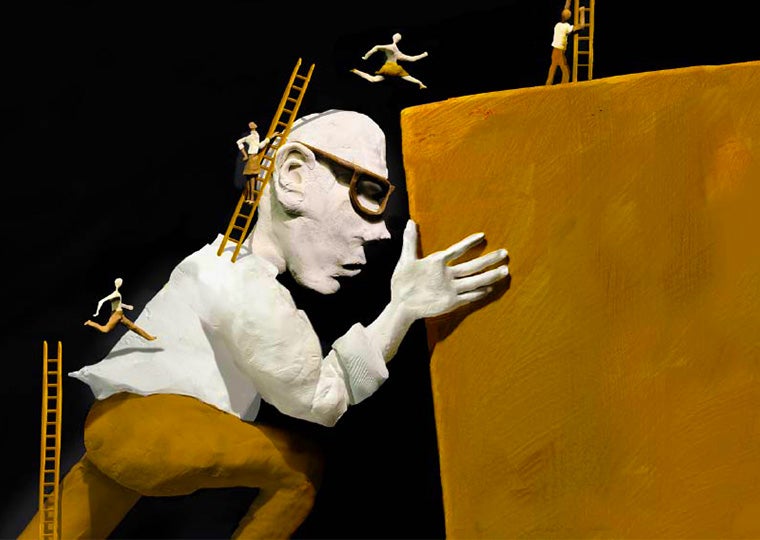
In Siddiq’s model, if AI makes everyone more productive, the bar for moving up the scoreboard rises, too. So everyone works harder just to keep up. Yet because everyone is pushing equally hard, no one really gets ahead. As a group, they’d all be better off working less. But with the scoreboard in place, the rat race is on. Management may see all that extra effort as a productivity win — which it is. For workers it comes at the price of a harder grind and higher risk of burnout.
A technology-enabled rat race can get going without forced ranking. Siddiq observes that when pay raises, bonuses and promotions are limited, employees understand that getting ahead may depend on outperforming colleagues, which compels them to work ever harder to stand out.
Hunker Down?
But there’s also a paradox potentially at play here too. As AI keeps raising the performance bar, Siddiq’s model suggests the smart move might be to prioritize not burning out. Pace yourself while others push too hard. Some of them drop out, and by simply staying in the game, you’re the winner. Ultimately, the pressure to compete can finally ease, letting workers actually benefit from the technology.
Siddiq’s model also suggests that policies meant to soften the edges of the work grind, such as flexible hours, can become, however inadvertently, the gateway for firms to push their employees even harder. In the model, improvements in working conditions initially make workers less likely to burn out.
But management then figures that workers who are less likely to burn out can take more pressure. So it ratchets up the stakes in the scoreboard rankings, and the grind intensifies. In a workplace where underlying burnout risk was already low, management’s response can more than wipe out the benefit of better conditions, leaving employees with more burnout than before.
Beware the Wellness Initiative
This leads Siddiq to offer a cautionary note on using wellness programs as a well-intentioned management corrective. Corporate spending on wellness benefits has expanded over the past decade or so. And recently there has been a decided shift from benefits focused on physical health, such as subsidized gym memberships, BMI screenings and step counters, to mental health counseling provided by outside firms, which would seem especially suited to addressing burnout.
In Siddiq’s model, a bigger wellness budget can actually be a sign of how hard a company pushes workers. He considers two types of firms. One is decidedly profit-seeking. The other also factors worker well-being into the equation.
When technology delivers relatively modest productivity gains, the profit-driven firm pushes its people harder, making burnout a greater risk. And burnout comes at a steep cost, not just to the affected worker. A recent estimate is that burnout costs an average U.S. company with 1,000 employees about $5 million a year, mostly through missed work. Replacing people is also very expensive.
In his model, the profit-driven firm spends more on prevention, such as wellness programs, to keep its people on the job. Yet because it keeps pushing them so hard, it still ends up with more burnout than the employee-minded firm.
The employee-minded firm takes a different route. It rejiggers its scoreboard so that beating co-workers counts for less, which takes the pressure off. Its people work less intensely, it spends less on prevention, and it still ends up with less burnout.
That said, this approach has its limits. When AI delivers big productivity gains, dialing back work intensity becomes more costly for a firm, because each hour of work produces so much more. Siddiq finds that under those conditions, the employee-minded firm may actually spend more on burnout prevention than the profit-driven firm. In the model, it seems that even the well-intentioned firm can’t resist the lure of much greater productivity. Rather than easing up on the pressure to work, it increasingly turns to wellness programs to manage the resulting burnout risk from pushing employees harder.
In either scenario the over-riding message is that wellness benefits, however generous, don’t necessarily slow the rat race.
Changing the scoreboard can.
For companies incorporating high-quality tech, such as AI, Siddiq suggests easing up on quotas that force managers to label a fixed share of employees as low performers or giving more weight to other measures of performance, such as collaboration. And when a company improves working conditions, he also suggests it should concurrently commit to not raise its performance targets if it is serious about addressing burnout risk.
Featured Faculty
-
Auyon Siddiq
Associate Professor of Decisions, Operations and Technology Management
About the Research
Siddiq, A. (2026). The rat race at work: Technology and burnout.