Megastudy: strategies reduce political animosity, but don't necessarily improve — and may harm — commitment to democratic principles
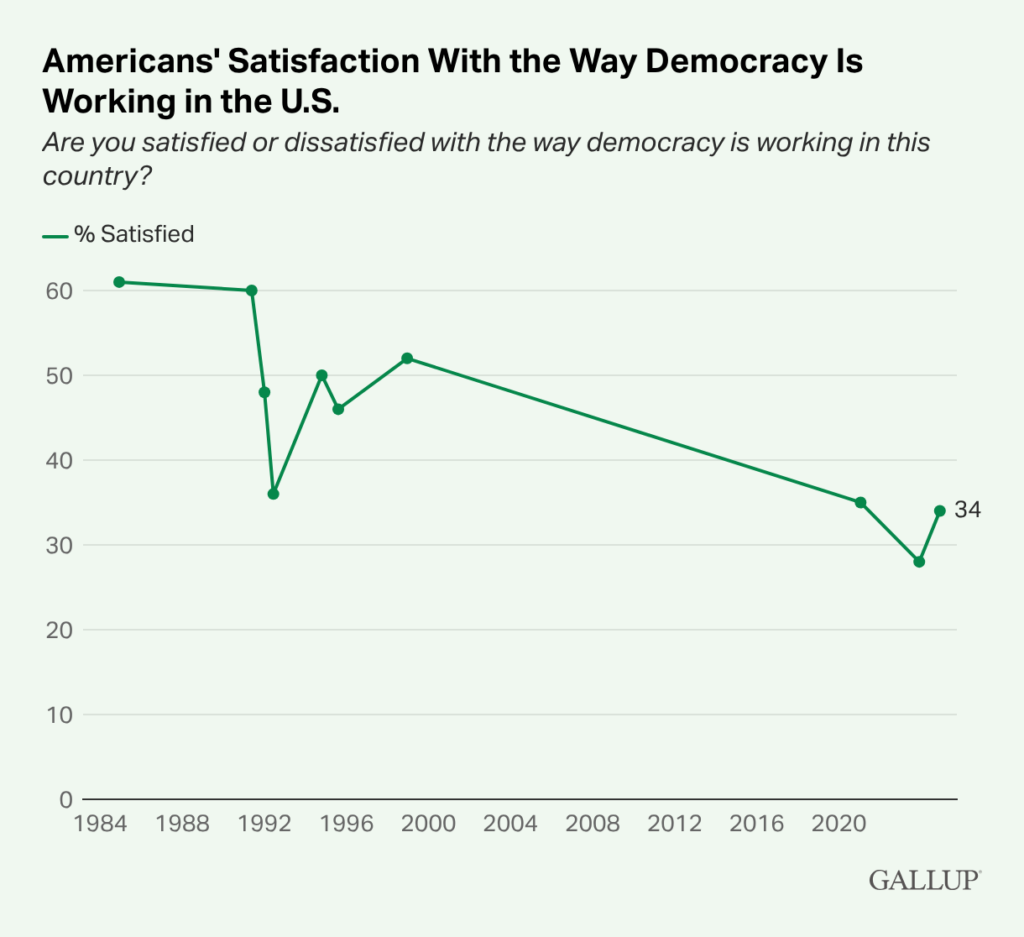
Democracy remains popular in America. A recent large-scale survey reported that two-thirds of Americans rate democracy as the best form of government. Yet over the past four decades we have given ever more negative performance reviews for how democracy is playing out. Gallup reports that just one-third of Americans are satisfied with how democracy is working these days, compared with more than 60% in the late 1980s.
And we’re well aware of what is at stake. In a 2025 survey of more than 4,500 Americans, more than 80% said democracy is in crisis or facing serious challenges.
While there are many drivers behind these trends — economic, cultural and social — rising partisan animosity has been seen as a major threat to democracy. Much research has focused on identifying ways to reduce the vilifying of the “other” party as a path toward finding more common ground in democratic principles.
A megastudy published in Science suggests that path is anything but straightforward.
Cornell’s Jan G. Voelkel, MIT’s Michael N. Stagnaro and Columbia’s James Y. Chu led a team of more than 60 researchers, including UCLA Anderson’s Hanne Collins, testing 25 different interventions simultaneously on more than 32,000 participants, a design that allowed for head-to-head comparison of each approach.
Encouragingly, 23 of the 25 interventions significantly reduced partisan animosity, the academic phrase for the hostility and contempt people feel toward those with different political beliefs.
Yet the same interventions were less effective at discouraging antidemocratic attitudes. Just six of the 25 strategies significantly reduced support for undemocratic practices. Moreover, four interventions actually backfired, increasing support for undemocratic behavior such as rejecting election results, supporting officials who don’t follow the constitutional balance of power or restricting the civil liberties of people with different political beliefs.
The stark difference in effectiveness of the same strategies on different goals upended a long-held assumption in the field. Many experts believed that interventions that successfully lowered partisan animosity would also reduce support for antidemocratic behavior. Before the study, a panel of experts predicted a strong correlation of 0.50 between the two. This research found a much weaker 0.25, suggesting that reducing partisan enmity does not reliably cascade into reduced support for undemocratic behavior.
“Partisan animosity is not a unifying construct underpinning the psychology of polarization and democracy,” the researchers explain.
Moreover, the impact of interventions that initially worked had substantially faded when the researchers checked back with participants two weeks later. The researchers posit that the strategies that worked in a one-off test need to be part of our day-to-day fabric — in media, in classrooms, in the general political discourse — to have a shot at lasting effect.
The research also revealed complexity in how Americans think about party and democracy. On a scale of zero to 100, participants were asked to rate their level of support for undemocratic behavior. The average score of 26.5 suggests Americans are decidedly against this. Yet when the question was would you vote for a candidate in your party who supported undemocratic behavior, the average score was 52.5. That’s actually consistent with prior research that has found Americans generally oppose undemocratic practices in principle, but remain willing to say they would vote for a candidate from their own party who engages in them.
Interestingly, this research points to one possible way to address that disconnect. Interventions that reduced partisan animosity also tended to reduce participants’ stated willingness to support an undemocratic candidate from their own party — even though those same treatments did nothing to reduce their broader tolerance for undemocratic practices.
Expert Crowdsourcing to Address Democracy Under Pressure
More than 250 approaches submitted by experts were whittled down to the core 25. The 32,000 participants were representative of Democrats and Republicans across key demographic benchmarks.
At its core, the researchers make a strong case that even relatively simple interventions can reduce partisan rancor.
The biggest reduction came from a video of two people with differing political views having a respectful conversation; that was enough to reduce partisan animosity by 10.5 percentage points compared with a control group. Telling people that most Americans are tired of the fighting and that media fuel the discord reduced it by more than 10 percentage points. Reminding people that all Americans share a national identity regardless of political affiliation drove it down by more than 9 percentage points.
Collins, who studies effective listening — and the many ways this breaks down in the face of attitude conflict — has documented in her prior work that people consistently believe that others are unwilling to listen to and learn about opposing views. She designed a simple intervention to overcome this biased belief wherein people read a message from someone on the other side who explicitly wants to learn about other perspectives. It ranked among the more impactful interventions for reducing partisan animosity.
Results for reducing support for undemocratic practices were more nuanced. The largest shift, a nearly 6 percentage point reduction, came when people were told that members of the other party don’t actually support breaking democratic norms. Showing videos of democratic collapse, from the streets of Venezuela to the Jan. 6, 2021, attack on the U.S. Capitol, reduced support for undemocratic behavior by nearly 5 percentage points. A third intervention produced a 2.2 percentage point reduction when people watched Democrats and Republicans learn that the other party is less extreme than they had believed.
When Interventions Backfire
Perhaps more telling was what backfired. Four interventions increased willingness to support undemocratic practices, and three of those had simultaneously done a good job of reducing partisan animosity. The same message that made people feel less hostile toward the other side also made them more comfortable with behavior that undermines democracy.
Telling people that most Americans are exhausted by political conflict and that the media manufactures division increased support for undemocratic practices by 1.0 percentage point. The researchers note that this was driven by the subset of participants who self-identified as conservative Republicans.
Asking people to write about someone from the other party they find likable and respectful increased support for undemocratic practices by 2.0 percentage points, the largest backfire of the four, driven primarily by conservative Democrats.
Telling people their side is dominating American politics had virtually no effect on partisan animosity but increased support for undemocratic practices by 1.5 percentage points, with the effect driven by conservative Democrats.
A fourth backfire came when people were told that the other party would not accept mass casualties (e.g., COVID-19 deaths) as a trade-off for electoral advantage. Support for undemocratic practices nonetheless increased by 1.0 percentage point, concentrated among the most conservative Republicans.
The researchers also tested the 25 interventions as tools for reducing support for political violence. Support for this is decidedly less common among Americans. On a scale of zero to 100, participants reported an average score of 10.8 for support for political violence, compared with 26.5 for support of undemocratic practices and 68.1 for partisan animosity.
Only five of the interventions reduced support for political violence; the largest drop was 2.8 percentage points when participant misperceptions about people with differing political views were corrected. And one intervention backfired: showing videos of the aftermath of when democracy collapsed abroad (e.g., Venezuela) followed by footage of the Jan. 6, 2021, attack on the U.S. Capitol, increased support for political violence by 2.3 percentage points, driven by the most conservative Republicans. The researchers suggest this subset appear to perceive Jan. 6 as a legitimate protest rather than an attack on democracy.
The study’s message is both encouraging and sobering. Reducing political enmity turns out to be surprisingly achievable. A short video, a reminder of shared identity, a willingness to listen. Yet for the results to persist likely requires institutional and societal commitment to keep the most effective strategies centered in our discourse. And perhaps most important is the finding that reducing political animosity is not a gateway to reducing support for undemocratic behavior. Both are necessary to preserve democracy, but they seem to require different playbooks.
Featured Faculty
-
Hanne Collins
Assistant Professor of Management and Organizations
About the Research
Voelkel, J. G., Stagnaro, M. N., Chu, J. Y., Pink, S. L., Mernyk, J. S., Redekopp, C., … & Willer, R. (2024). Megastudy testing 25 treatments to reduce antidemocratic attitudes and partisan animosity. Science, 386(6719), eadh4764.