Even counting grads who want a job but aren’t looking, summer 2026 looked like other recent summers
Even before artificial intelligence entered the conversation, young college graduates were having a somewhat harder time landing jobs.
As the graph below shows, the unemployment rate for recent college grads (bachelor’s degree or higher, between the ages of 22-27) was below the level for all workers between 2016 through 2019. It then began to edge above the general workforce rate, and beginning in 2022 college grad unemployment rates were discernibly higher.
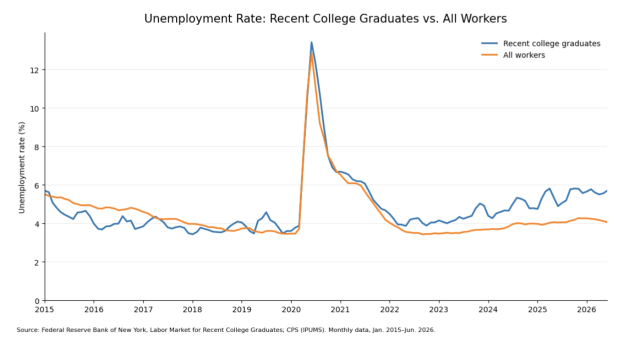
There is plenty of debate about what may be driving the widening gap in those unemployment rates — it averaged about 1.5 percentage points in the first half of 2026 — with a lot of fingers being pointed at how AI could be upending the need to hire college grads for entry-level jobs.
Earlier in 2026, BlackRock CEO Larry Fink said “When this year’s college graduates enter the workforce, we could see the highest unemployment rate among them in years — even without a recession.”
Not yet, at least, according to a working paper from UCLA Anderson’s Robert W. Fairlie and Jane Wu.
Fairlie and Wu report that this summer’s unemployment rate for 22- to 25-year-olds with a bachelor’s degree who were no longer in school was not significantly higher than in previous summers going back to 2022.
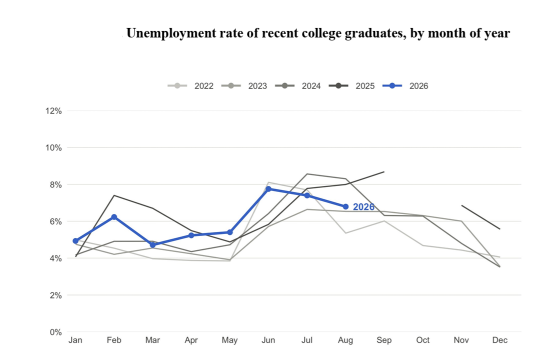
Fairlie and Wu are careful to note that their findings show whether unemployment rose, not what role AI did or didn’t play. Their focus on unemployment data covering June through August is akin to a stress test: That’s when recent grads look to enter the market in force. Fairlie and Wu note that unemployment for this cohort typically runs nearly 2 percentage points higher in summer than during the rest of the year.
While the 7.3% average rate for summer 2026 was higher than the same periods in 2022, 2023 and 2025, it was lower than the 7.8% rate in 2024. Fairlie and Wu note that businesses ramped up AI spending and its use in late 2025 and into 2026, making summer 2026 a particularly useful first test of college-grad hiring prospects as AI becomes more deeply embedded in the workplace.
The researchers also looked at how occupations in which AI can be deployed effectively were impacted. While unemployment point estimates were slightly higher in more AI-exposed occupations, the differences were small and not statistically significant.
Nor did recent grads lose significant ground compared with older college grads (30-49) or workers in the same 22-25 age range without a college degree.
Fairlie and Wu also teased out a broader measure they call “sidelined unemployment.” It adds in recent grads who say they want a job but haven’t actively looked in the past four weeks, so they don’t count in the official rate. The sidelined rate hit 10.4% this summer, the highest of the five summers they studied, though — again — the increase wasn’t statistically significant.
While Fairlie and Wu find that recent grads have not, on average, been significantly worse off getting a job in the summer of 2026 compared with the recent past, separate studies published by the Census Bureau and the Federal Reserve Bank of Dallas in September 2026 suggest the struggle is real, for some, on a more granular level. Grads in majors most exposed to AI, computer science in particular, have been slower to land that first job. The Census research also finds that when the most AI-exposed grads do find work, they are more likely than in the past to land in lower-paying industries such as retail and restaurants, and they are earning less. (Neither study includes 2026’s class.)
Fairlie and Wu can’t distinguish grads by major in their data so they cannot test that directly. They do however, use their aggregate data to also examine an emerging theory that remote work may be a factor in the higher unemployment rates for recent college grads. Younger workers benefit from the mentoring, feedback and informal learning that come with being in an office, potentially making employers more reluctant to hire inexperienced workers for remote jobs.
Unemployment was relatively higher in summer 2026 among recent grads associated with occupations that can be done remotely. But there’s a complication: Jobs that can be done remotely also tend to be more exposed to AI, making it difficult to cleanly separate the two.
For now, the summer of 2026 offers little evidence of a broad AI-driven unemployment increase for young job seekers with a bachelor’s degree. But Fairlie and Wu’s work comes with an important timestamp, as AI use in the workplace is still evolving rapidly. Future graduates may encounter a different job market.
Featured Faculty
-
Robert W. Fairlie
Department of Public Policy Chair; Professor of Public Policy
-
Jane Wu
Assistant Professor of Strategy
About the Research
Fairlie, R., & Wu, J. (2026). The Early Impacts of AI on Employment Among Recent College Graduates.